巓
Character Story & Explanation
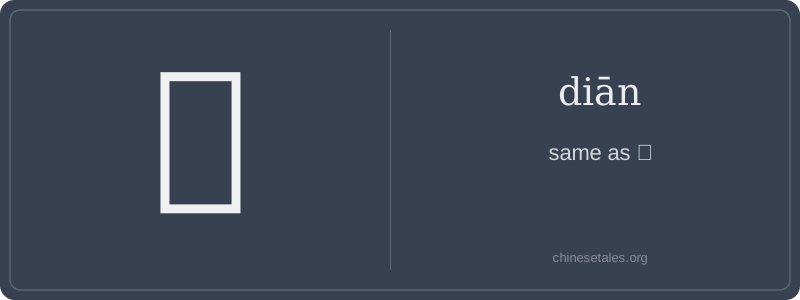
The earliest ancestor of 巓 appears in late Warring States bamboo texts and Han dynasty seals, where it evolved from the same pictographic root as 巔: a simplified depiction of a person (人) standing atop a mountain (山). In 巔, the 'person' component is clearly rendered as 亻+丷+一, while 巓 replaces that with a more ornate, symmetrical head-and-arms motif — three horizontal strokes capped by a curved 'crown' (⺌), suggesting ritual elevation or ceremonial posture. Over centuries, scribes standardized the upper element to resemble a stylized 'crown' or 'summit cap', emphasizing sovereignty over height. The lower 山 radical remained unchanged — anchoring the meaning in geography and scale.
This visual evolution mirrors its semantic journey: from literal mountain top in early Zhou bronze inscriptions ('the king ascended the 巓 to sacrifice') to a metaphysical symbol in Daoist and Chan Buddhist texts — where 'reaching the 巓' meant attaining enlightenment beyond duality. Li Bai used 巔 in his famous 'Hard Road to Shu' to evoke vertiginous transcendence; later, Song dynasty painters inscribed 巓 on scrolls depicting solitary sages gazing from cloud-wrapped summits. Its form — elegant, balanced, slightly ceremonial — reflects how classical China saw the peak not just as terrain, but as a threshold between human and celestial realms.
At its heart, 巓 (diān) is the poetic, archaic twin of 巔 — both meaning 'summit', 'peak', or 'apex', evoking the awe and stillness of a mountain’s highest point. It’s not a word you’ll hear in daily conversation — no one orders 'a peak of tea' — but it appears in classical poetry, calligraphy inscriptions, and formal literary prose, where it carries a weighty, almost spiritual resonance: think of standing breathless at the top of Mount Tai, gazing into mist-shrouded eternity. The character doesn’t function as a verb or adjective on its own; it’s almost always part of compounds like 巔峰 (diānfēng, 'peak/zenith') or used metaphorically for the pinnacle of achievement ('the peak of artistic mastery').
Grammatically, 巓 behaves identically to 巔 — they’re orthographic variants, not different words. That means if you see 巓 in a text, you read it *exactly* as diān, and it fits wherever 巔 would: as a noun modifier (e.g., 巓顶, 'mountain summit'), in parallel structures ('reaching the peak and touching the sky'), or as a standalone noun in poetic lines. Crucially, it never stands alone in modern speech — unlike English 'peak', you’d never say 'Let’s climb the 巓'; you’d say '登巔' (dēng diān) or '登上山巔'.
Culturally, 巓 reveals how Chinese values precision *and* aesthetic flexibility: two characters, identical sound and meaning, yet subtly distinct in brushstroke rhythm and historical usage. Learners often mistakenly treat 巓 as 'more formal' or 'more correct' — but it’s neither; it’s simply a variant preserved in certain editions, dictionaries, and calligraphic traditions. The biggest trap? Assuming it’s rare because it’s absent from HSK — in fact, it appears frequently in Tang-Song poetry anthologies and museum inscriptions. Read it with reverence, not confusion.