巍
Character Story & Explanation
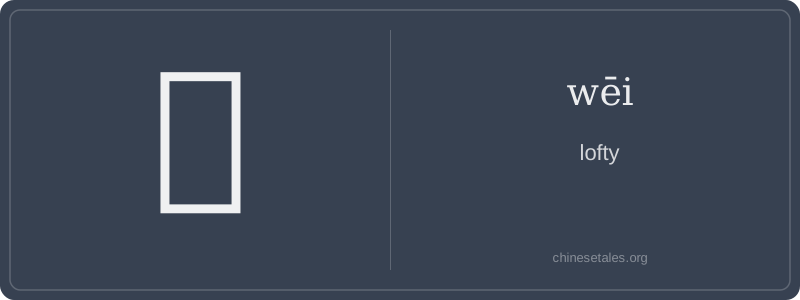
The earliest form of 巍 appears in bronze inscriptions (c. 1000 BCE) as a triple mountain (屾) stacked vertically over a base resembling 山 — essentially three peaks rising in succession, emphasizing overwhelming height and layered mass. Over centuries, the triple peak simplified into the top component we see today: the radical 山 (mountain) crowned by two 'high' markers — the left side (彳 + 山) evolved from a walking path ascending steep terrain, while the right side (魏) was originally a separate character meaning 'tall city walls', later borrowed phonetically. By the Han dynasty, the structure stabilized into its current 20-stroke form: 山 (radical) + 魏 (phonetic component, also reinforcing 'grand scale').
This visual stacking mirrors its semantic evolution: from literal mountain height in early poetry (e.g., the *Chu Ci*’s '巍巍南山' — 'Lofty, lofty Southern Mountains') to metaphorical loftiness in Tang and Song dynasties — describing imperial virtue, scholarly integrity, or Daoist transcendence. The character’s very density — 20 strokes, one of the most complex in common literary use — enacts its meaning: reading it feels like climbing.
巍 (wēi) is the kind of word that makes you tilt your head back — not just to read it, but to *feel* it. It doesn’t just mean 'lofty'; it evokes sheer, awe-inspiring verticality: jagged mountain peaks piercing clouds, ancient temples perched on cliffs, or even a person’s unshakable moral stature. Unlike generic synonyms like 高 (gāo, 'tall'), 巍 carries weight, grandeur, and quiet majesty — it’s poetic, literary, and almost never used for everyday objects (you wouldn’t say 巍的椅子 for 'a tall chair').
Grammatically, 巍 is almost always an adjective, but it rarely stands alone. It appears in fixed compounds (like 巍峨 or 巍然) or as a descriptive modifier before nouns — and crucially, it *requires* context that justifies its gravity. Learners sometimes mistakenly use it predicatively ('The mountain is 巍'), but native usage prefers 巍峨 or 巍然屹立. It also appears in classical set phrases like 巍巍乎 (wēi wēi hū), echoing Confucius’ praise for the virtuous sage — a rhetorical flourish no modern speaker would improvise.
Culturally, 巍 is deeply tied to China’s mountain cosmology: mountains aren’t just landforms — they’re axes mundi, bridges between heaven and earth. That’s why 巍 appears in names like 巍山 (Wēishān Mountain) and in political rhetoric ('巍然不动' — 'unshaken, impregnable') to evoke national resilience. A common mistake? Using it where 高 or 崇高 would suffice — making your sentence sound unintentionally archaic or melodramatic, like describing a coffee cup as 'lofty' in English.