岿
Character Story & Explanation
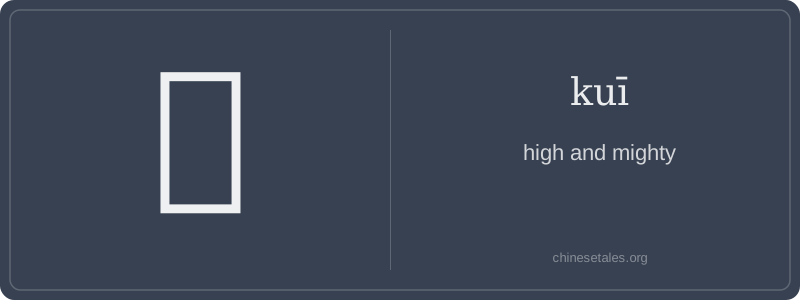
The earliest form of 岿 appears in bronze inscriptions as a stylized triple-peak mountain (山) stacked atop a simplified 'gui' (圭) shape — not the jade tablet, but an archaic phonetic component hinting at pronunciation. Over time, the top evolved into two parallel horizontal strokes (like a balanced crown), the middle became a compressed '山' radical (three peaks reduced to three short diagonals), and the bottom solidified into '巾' (jīn, cloth) — though this '巾' is purely phonetic, not semantic. By the seal script era, the character had stabilized into its modern eight-stroke structure: 山 (3 strokes) + 二 (2 strokes, representing symmetry and height) + 巾 (3 strokes, lending the kuī sound).
Its meaning crystallized during the Han dynasty, appearing in texts like the *Huainanzi* to describe cliffs 'so lofty they pierce the clouds' — not merely tall, but *authoritatively so*. Later, in Tang poetry and Song essays, 岿 shifted subtly toward metaphorical steadfastness: a scholar’s integrity '岿然不屈', a temple '岿然矗立' through dynastic collapse. The visual design reinforces this — the balanced horizontals above the mountain suggest both stability and elevation, while the '巾' base grounds it like a ceremonial banner planted on summit rock. This fusion of sound, shape, and symbolism made 岿 a rare lexical jewel: a character that looks like a monument and reads like one.
Imagine standing at the foot of a mountain so ancient and unshakable that even centuries of wind, rain, and war have barely scratched its flanks — that’s 岿 (kuī) in action. This isn’t just 'tall' or 'big'; it’s *majestic endurance*. In classical Chinese, 岿 evokes awe-inspiring verticality and immovable dignity — think of a cliff face carved by time, not a skyscraper built last year. It’s almost never used alone; you’ll nearly always find it in compounds like 岿然 (kuī rán), where 然 adds the sense of 'in this manner', turning it into an adverbial phrase meaning 'unshaken, toweringly steadfast'.
Grammatically, 岿 is fossilized in literary and formal registers: it appears in set phrases, idioms, and descriptive writing — never in casual speech or beginner textbooks (hence its absence from HSK). Learners often mistakenly try to use it like a standalone adjective ('this mountain is 岿'), but it doesn’t work that way. Instead, it functions like a poetic anchor: 岿然不动 (kuī rán bù dòng) means 'utterly unmoved', as if gravity itself respects its resolve. You’ll see it in news reports describing institutions weathering crises, or essays praising cultural continuity.
Culturally, 岿 carries Confucian weight — it’s less about physical height and more about moral or structural inviolability. A common mistake is confusing it with similar-sounding kuī characters like 圭 (guī, jade tablet) or 归 (guī, to return), but those lack the mountain radical and the visceral sense of geological permanence. Also, note: while 山 (mountain) is its radical, 岿 isn’t about mountains per se — it’s about *what mountains symbolize*: unassailable presence, silent authority, and time-defying calm.