巉
Character Story & Explanation
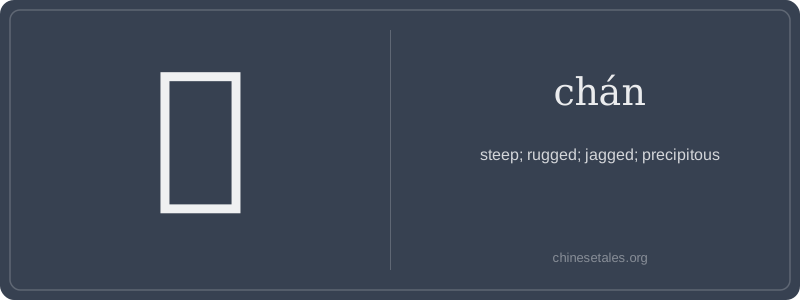
The earliest form of 巉 appears in seal script (zhuànshū), not oracle bone—its complexity suggests late Bronze Age or early Warring States origin. Visually, it’s a double mountain (山) stacked vertically, flanked by two 'stone' radicals (石) on left and right, with a central 'sharp edge' element (彡) suggesting fracturing or serration. Over centuries, the top 山 compressed into two parallel strokes, the side 石 simplified into radical 彡 (often mistaken for 'hair' but here implying *radiating sharpness*), and the lower 山 fused with a vertical stroke—yielding today’s 19-stroke masterpiece. Every stroke feels like a fissure.
Its meaning crystallized in the Tang dynasty: Du Fu wrote of 巉崖 in his frontier poems, evoking desolate grandeur. The character’s very structure mirrors its semantics—dual mountains + stone + sharp lines = geological violence made visible. Unlike generic words for 'high', 巉 implies danger, age, and resistance: cliffs that defy ascent, peaks that repel cultivation. In classical texts, it often appears paired with verbs of gazing or trembling—never climbing. It’s less a description than a warning etched in ink.
Imagine standing at the base of a sheer mountain cliff—wind whipping, rock face splitting the sky like shattered porcelain. That’s 巉 (chán): not just 'steep', but *viscerally* jagged, *uncompromisingly* precipitous. It evokes raw, untamed geology—no gentle slopes here. In classical and literary Chinese, 巉 is almost exclusively adjectival and poetic, modifying nouns like 山 (mountain), 崖 (cliff), or 峰 (peak). You’ll rarely hear it in daily speech—it’s reserved for calligraphy, poetry, travel essays, or dramatic descriptions: 巉岩 (chán yán, 'jagged rocks'), 巉峻 (chán jùn, 'ruggedly steep').
Grammatically, it behaves like a stative adjective: no aspect particles (了, 过), no reduplication, and never used predicatively without a copula or modifier. Learners often mistakenly try to say *'山很巉'*—but that’s unnatural; native speakers say *'山势巉峻'* ('the mountain’s contour is rugged') or *'巉岩嶙峋'* ('jagged, craggy rocks'). It thrives in compound pairs, especially with synonyms like 峻, 嶙, or 峭—never stands alone.
Culturally, 巉 carries Daoist and Tang-Song poetic weight: it’s the kind of word Li Bai used to convey nature’s awe-inspiring indifference. Mistake it for a simple synonym of 高 (tall) or 陡 (steep), and you lose its texture—the sense of fractured, wind-sculpted stone. Also, watch your tone: chán (second tone) is easily mispronounced as chǎn (third tone)—which means 'to scrape' or 'to excavate'! One tone shift turns poetry into construction work.