巇
Character Story & Explanation
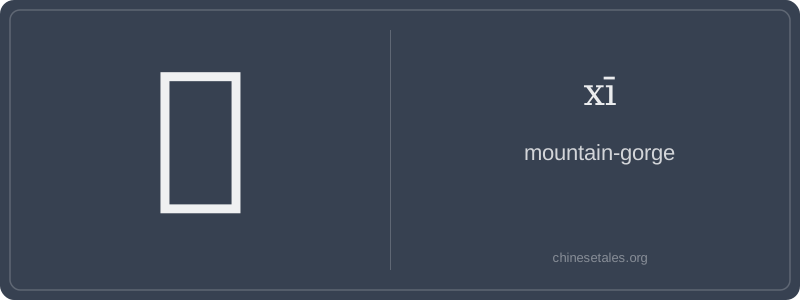
The earliest form of 巇 appears in bronze inscriptions as a vivid pictograph: two parallel vertical lines representing towering cliffs, with a wavy, serpentine line snaking tightly between them — unmistakably a gorge carved by water or time. Over centuries, the wavy line simplified into the central ‘巛’ (three-stroke variant of 川, meaning ‘river’), while the flanking cliffs evolved into the left ‘山’ (mountain) and right ‘巛’-plus-‘彐’ structure — the latter stylized from cliff contours and rock strata. By the Han dynasty, 巇 had crystallized into its current shape: 山 + 巛 + 彐, visually echoing a mountain *containing* a river-carved fissure.
This visual logic anchored its meaning: not just any valley, but a narrow, deep, mountain-enclosed passage — the kind that appears in Tang dynasty poetry as a symbol of isolation and transcendence. Li Bai wrote of ‘巇壑藏云’ (gorges hiding clouds), and Song painters labeled misty ravines on silk scrolls with 巇 to signal profound depth and mystery. Its rarity today isn’t due to obsolescence, but preservation: 巇 survived not as everyday vocabulary, but as a lexical fossil — perfectly preserved in literary ecology, exactly as it was first etched in bronze.
Imagine standing at the edge of a narrow, mist-wrapped mountain pass where sheer cliffs rise like ancient sentinels — that’s the visceral feeling of 巇 (xī). It doesn’t mean ‘mountain’ or ‘gorge’ separately; it’s the *fusion* of both: a deep, winding cleft *within* a mountain, often steep, shadowed, and geologically dramatic. In classical Chinese, it evokes poetic solitude and natural grandeur — think Du Fu gazing into a ravine at dusk, not a tourist snapping selfies at a scenic overlook.
Grammatically, 巇 is almost exclusively literary and nominal — you’ll never hear it in daily speech or see it in compound verbs. It appears mainly in set phrases (like 巇谷 or 巇壑), classical poetry, or geographical names (e.g., a specific gorge in Sichuan). Learners sometimes mistakenly treat it as a verb ('to gorge') or try to use it alone — but 巇 *never* stands solo in modern usage; it always needs a modifier or partner word. Also, its tone (xī, first tone) is easily mispronounced as xí or xǐ — remember: it’s the calm, high-pitched ‘shhh’ of wind slipping silently through stone.
Culturally, 巇 carries a quiet weight: it’s associated with reclusion, Daoist stillness, and the sublime power of untouched nature. Unlike common words like 山 (shān, ‘mountain’) or 峡 (xiá, ‘canyon’), 巇 feels older, rarer, and more deliberate — like choosing ‘ravine’ over ‘valley’ in English for its sharper, wilder connotation. Mistaking it for similar-looking characters (like 峡 or 溪) risks sounding either archaic or unintentionally poetic — a beautiful accident, but one that breaks fluency.