嶷
Character Story & Explanation
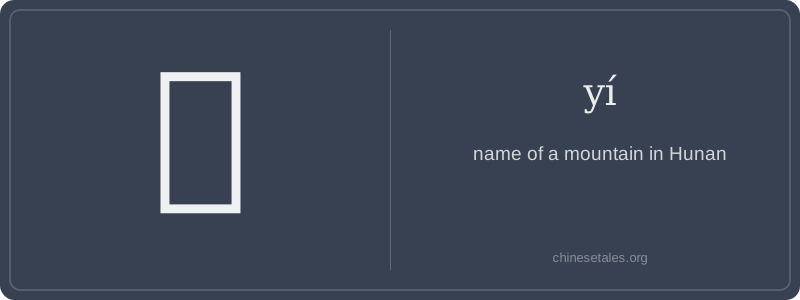
The earliest form of 嶷 appears in bronze inscriptions of the late Zhou dynasty — not as a pictograph of a mountain per se, but as a stylized triple-peak motif (山) fused with an elegant, sinuous element resembling a ceremonial banner or flowing stream (疑, the phonetic component). Over centuries, the top 山 radical solidified into its modern three-stroke shape, while the lower part evolved from 疑’s complex structure — losing its 'heart' (心) and 'standing person' (立) components — into the streamlined 12-stroke form we see today. Crucially, the original 疑 was chosen not for meaning, but sound: both 疑 and 嶷 were pronounced *ŋrəj in Old Chinese — making this a classic phono-semantic compound.
By the Han dynasty, 嶲 (an early variant) and later 嶷 became fixed as the name of a sacred mountain in southern Hunan, associated with Emperor Shun’s final years — a theme echoed in the Shiji and Chu Ci. The character’s visual weight — 17 strokes, tall and layered — mirrors how classical writers treated the mountain: not as terrain, but as moral topography. Its height wasn’t measured in meters, but in virtue — hence why it appears alongside words like 懿德 (yì dé, 'excellent virtue') in parallel constructions, even though the characters share no semantic root.
Think of 嶷 (yí) like the 'Mount Rushmore' of Chinese mountain names — not famous for tourism or hiking, but because it’s carved into history as a proper noun with gravitas. It doesn’t mean 'mountain' in general (that’s 山 shān); it’s the specific, ancient name of Yí Mountain in Hunan — a real place tied to legendary Emperor Shun’s retreat and burial. In modern usage, it appears almost exclusively in classical allusions, historical texts, or poetic place names — never in daily speech or HSK vocabulary. You won’t hear it in a restaurant or on a subway map.
Grammatically, 嶷 functions only as a noun — always capitalized in effect, like 'Olympus' in English. It never takes measure words, doesn’t pluralize, and isn’t used adjectivally ('mountainous') or verbally ('to mountain'). If you try to say 'a lofty, 嶷-like peak', you’ll confuse native speakers — it’s not a descriptive word. Its pinyin yí sounds identical to 易 (easy), 宜 (suitable), and 疑 (doubt), so learners often mispronounce or misassign meaning when reading aloud from classical passages.
Culturally, 嶷 carries quiet authority: it’s one of those characters that signals 'you’re now in the realm of Sima Qian or the Book of Documents.' Mistake it for 懿 (yì, 'virtuous') or 嶂 (zhàng, 'barrier mountain'), and you’ll derail both pronunciation and meaning. And no — it’s not related to 'Yi' as in 'Yi dynasty' or 'Yi people'; that’s a different character entirely. This is geography as legacy, not linguistics as logic.