岙
Character Story & Explanation
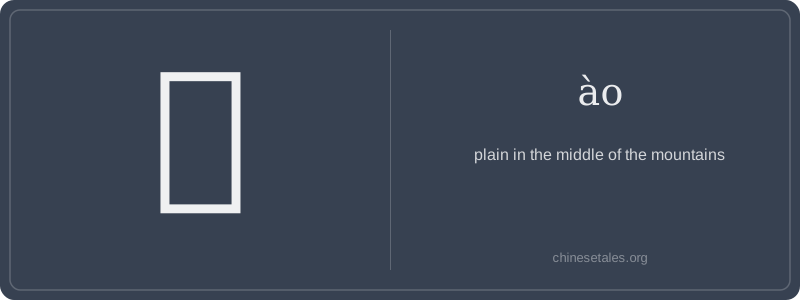
The earliest form of 岙 appears in seal script (not oracle bone, as it’s relatively late), built clearly from the radical 山 (mountain) on the left and the phonetic component 敖 (áo, 'to wander; lofty') on the right. Visually, it’s 山 + 敖 — but note: 敖 itself combines ‘leisurely walking’ (a person 幺 + 土) with ‘raised platform’ (方), evoking a place one wanders *into* and *up to*. Over time, the right side simplified: 敖’s complex structure condensed into the modern four-stroke 敖-like shape — still echoing movement toward elevation, yet now anchored by 山’s weight.
This visual logic became semantic reality: an ào isn’t just any lowland—it’s a plain *you arrive at after ascending*, then find yourself surrounded. Classical texts rarely use it (it’s too local), but Ming-Qing regional gazetteers from southern Zhejiang overflow with 岙-names, reflecting Han migration into rugged terrain. The character didn’t describe imperial geography—it described where farmers built terraced fields and stone houses, safe inside the mountain’s embrace. Its form literally says: ‘mountain + the place you wander up to and settle’.
Imagine hiking deep into Zhejiang’s mist-shrouded hills, where suddenly the path opens into a hidden, sun-dappled basin—grassy, quiet, ringed by steep slopes. That secluded mountain plain is an ào: not a valley carved by rivers (that’s gǔ 谷), nor a broad plateau (yuán 原), but a small, sheltered lowland *nestled within* mountains—like nature’s secret courtyard. This is the soul of 岙: intimacy, enclosure, and geographical humility.
Grammatically, 岙 appears almost exclusively in proper nouns—place names—especially in coastal Zhejiang and Fujian: Yinzhou District’s Dong’ao (东岙), Ninghai’s Ximen’ao (西门岙). You’ll rarely see it in verbs or adjectives; it’s a noun-only relic, frozen in toponymy. Learners often mistakenly treat it as a generic word for 'valley' or try to use it in compound verbs—big no-no. It’s not ‘mountain + something else’; it’s a single lexical unit meaning *that specific kind of plain*, and only lives in names.
Culturally, 岙 reveals how Chinese geography words encode micro-ecologies: while shān (山) means mountain broadly, and gǔ (谷) implies depth and flow, 岙 whispers of human settlement—small villages tucked into these basins for centuries, shielded from wind and war. Mistake it for ào (奥, 'profound')? You’ll sound like you’re describing metaphysical depth instead of topography. And yes—it’s pronounced ào, but *never* used like the common ào (奥) in phrases like shēn’ào (deeply profound). Respect its niche.