嶭
Character Story & Explanation
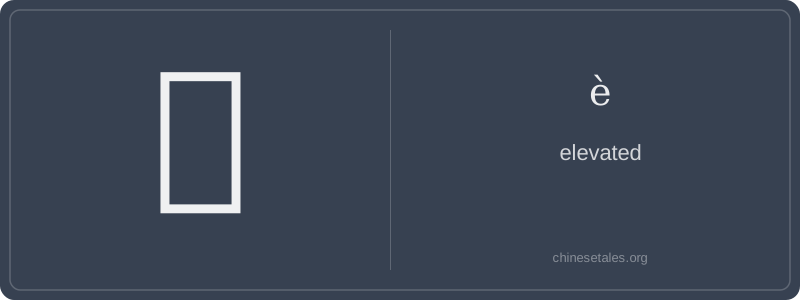
The earliest form of 嶭 appears in bronze inscriptions (c. 1000 BCE) as a composite pictograph: a simplified mountain radical (山) stacked atop a phonetic component resembling ‘咢’ (a mouth open wide, suggesting resonance or height). Over centuries, the upper part evolved from a stylized ‘咢’ — originally depicting a person shouting upward — into today’s ‘噩’-like top, while the lower ‘山’ remained stable. By the Han dynasty, the structure solidified into its current 19-stroke form: three parallel horizontal strokes (representing layered peaks), two verticals flanking them (cliffs), and a dense cluster above (echoing the ‘mouth’ + ‘four mouths’ motif of 噩, implying overwhelming height).
This visual logic mirrors its semantic journey: from ‘a shout echoing off sheer cliffs’ → ‘place where sound rises and lingers’ → ‘inherently lofty, unassailable terrain’. In the Classic of Mountains and Seas (Shānhǎi Jīng), 嶭 appears in descriptions of mythical peaks where immortals dwell — always paired with words like ‘峻’ (steep) and ‘巘’ (jagged crest). Its rarity isn’t neglect; it’s preservation — a linguistic fossil encoding how ancient Chinese perceived elevation not as measurement, but as sacred vertical silence.
First, let’s clear up a big misconception: 嶭 (è) doesn’t mean 'elevated' in the everyday sense — it’s not used like ‘elevated platform’ or ‘elevated mood’. It’s an archaic, literary character meaning ‘high’, ‘lofty’, or ‘towering’, almost exclusively in poetic, classical, or place-name contexts. Think of it as the Chinese equivalent of English words like ‘aerie’ or ‘eminence’ — beautiful, precise, and rarely spoken aloud. Its feel is vertical, imposing, and serene — like mist curling around mountain peaks at dawn.
Grammatically, 嶭 is almost never used alone in modern Mandarin. You’ll find it only in fixed compounds (like 嶭嶺 or 嶭崿), classical poetry, or historical toponyms (e.g., ancient texts referencing 嶭山). It functions as an adjective, but never predicatively — you won’t say ‘this mountain is 嶭’; instead, you’d write ‘嶮嶭之巔’ (the towering summit) in a couplet. Learners often mistakenly try to use it like 高 — a classic trap that makes sentences sound like they’re quoting a Tang dynasty scroll at a coffee shop.
Culturally, 嶭 carries the quiet weight of classical landscape aesthetics — it evokes shanshui (mountain-water) painting and Daoist reverence for vertical stillness. It’s also frequently misread as è (‘to restrain’) or è (‘hungry’), especially in cursive script. The biggest mistake? Assuming it’s interchangeable with 峨 (é) — which *also* means ‘towering’ but is far more common and phonetically distinct. Remember: 嶭 is the rare, silent peak — not the loud, everyday high.