峃
Character Story & Explanation
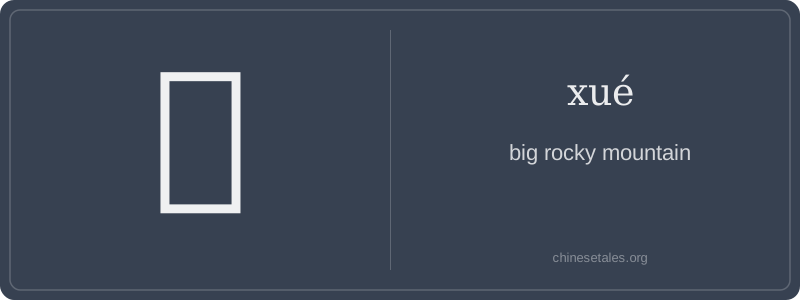
The earliest form of 峃 appears in bronze inscriptions of the late Zhou dynasty — not as a single unified character, but as a combination: 山 (mountain) drawn with three jagged peaks, fused beneath a stylized 'rock' element (originally 岩 or 石 in simplified form). Over centuries, the upper part condensed into the top component we see today — resembling two stacked rocks (the 'two dot-rocks' radical 厂 + 石 merged visually), while the lower 山 remained unmistakably mountainous. By the Han dynasty clerical script, the strokes had stabilized: the upper part became 厂 (cliff overhang) cradling 石 (stone), all anchored by 山 — literally 'rock-cliff-mountain' in one glyph.
This triple-layered visual logic reflects its semantic depth: it doesn’t just mean 'big mountain' — it means 'mountain defined by its rockiness', where geology overrides geography. In classical texts like the *Shuǐ Jīng Zhù* (Commentary on the Water Classic), 峃 appears only when describing peaks so rugged they resisted cultivation or settlement — places associated with recluses, sages, and boundary markers between realms. Its enduring presence in temple inscriptions and regional toponyms (e.g., Guìzhōu’s ancient 峃山) confirms its role as a lexical fossil — preserving a pre-modern worldview where mountains weren’t scenery, but sovereigns of stone.
Think of 峃 (xué) as China’s version of ‘Mount Doom’ — not mythical, but geologically imposing: a massive, craggy, unyielding rocky mountain, often so sheer and ancient that it feels less like terrain and more like a geological monument. Unlike common mountain words like 山 (shān) — which is generic and friendly, like 'hill' or 'mountain' on a map — 峃 carries weight, age, and awe. It’s not used for hiking brochures or travel blogs; it’s the kind of word you’d find carved into a Tang dynasty stele or whispered by a Daoist hermit describing the peak where immortals gather.
Grammatically, 峃 is almost never used alone. It’s strictly literary and nearly always appears in compound nouns — especially poetic or classical place names (e.g., 嵩峃, 霍峃) or descriptive phrases like 峃巖 (xué yán), meaning 'jagged, rocky cliffs'. You won’t hear it in spoken Mandarin — no one says *'wǒ qù dēng xué'* ('I’m climbing a 峃'); that would sound like quoting a Song dynasty scroll. Instead, it functions like English’s 'crags', 'fastness', or 'aerie' — evocative, rare, and context-dependent.
Learners often misread it as xuè (like 血) or confuse it with 学 (xué, 'study') due to identical pronunciation — a classic homophone trap. But while 学 invites you to open a textbook, 峃 demands you look up — way up — at stone older than cities. Its rarity makes it a quiet test of textual literacy: if you recognize 峃, you’re not just reading Chinese — you’re reading history in granite.