峣
Character Story & Explanation
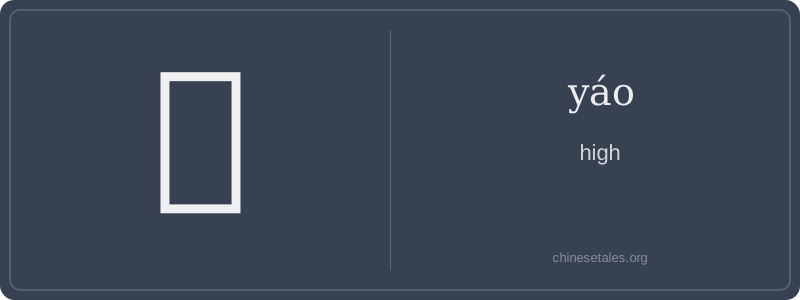
The earliest form of 峣 appears in seal script (around 200 BCE), composed of 山 (shān, 'mountain') on the left — unmistakably three jagged peaks — and 爻 (yáo), a phonetic component on the right that originally depicted intersecting divination rods (like the lines in the I Ching hexagrams). Over centuries, the mountain radical simplified from three distinct peaks to the modern three-stroke 山, while 爻 evolved from two crossed X-shaped strokes into its current symmetrical, crisscrossed form — visually echoing the tangled, layered heights of steep terrain.
This fusion wasn’t arbitrary: ancient scribes chose 爻 not just for sound, but for resonance — in early cosmology, the intersecting lines symbolized dynamic, layered cosmic forces, perfectly matching the idea of height as complexity, challenge, and sacred distance. The character appears in the 3rd-century CE dictionary Shuōwén Jiězì as 'high and steep', and later in Du Fu’s poems describing the perilous roads to Sichuan — where '峣关' (Yáo Guān) referred to a famously towering frontier pass, its name literally encoding both altitude and strategic awe.
Think of 峣 (yáo) as the Chinese equivalent of 'towering' in English—not just tall, but *impressively*, almost mythically high, like the Gothic spires of Notre-Dame piercing the clouds or the Himalayas scraping the stratosphere. In Chinese, it’s not a casual descriptor; it carries poetic gravity and visual grandeur, almost always modifying nouns like mountains, towers, or cliffs—and rarely used alone. You won’t hear someone say '那座楼很峣' in daily speech; instead, it appears in literary phrases like 峣嵲 (yáo niè), where the doubling intensifies the sense of awe-inspiring verticality.
Grammatically, 峣 is strictly an adjective—never a verb or noun—and almost never appears without a companion character. It doesn’t take degree adverbs (no '很峣' or '非常峣'); its power lies in classical collocation, not modern syntax. Learners often mistakenly treat it like common adjectives (e.g., 高), but doing so sounds jarringly archaic or even nonsensical—like saying 'verily lofty' in a coffee order. Its usage is tightly bound to fixed compounds, especially in poetry, historical descriptions, or formal landscape writing.
Culturally, 峣 evokes the Daoist and Confucian reverence for vertical ascent as moral or spiritual elevation—mountains aren’t just landforms; they’re ladders to heaven. Mistaking it for everyday 'high' risks sounding like you’re quoting Tang dynasty poetry at a subway station. Also, watch the tone: yáo (second tone, rising) is easily confused with yǎo (third tone, dipping), which means 'deep'—a semantic opposite that could turn your majestic peak into an abyss!