嶡
Character Story & Explanation
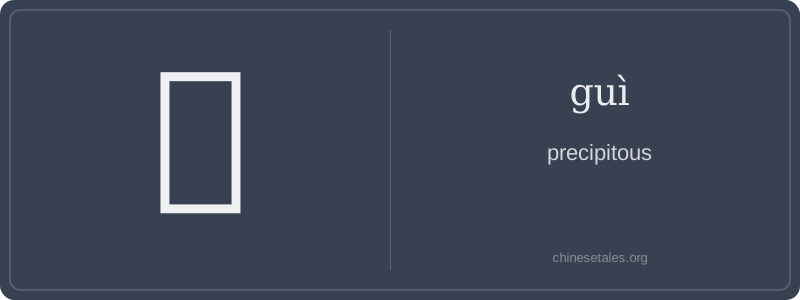
The earliest form of 嶡 appears in seal script (around 200 BCE), where it clearly shows 山 (mountain) on the left and 圭 (guī — a ceremonial jade tablet with sharp, squared edges) on the right. The jade tablet wasn’t chosen randomly: in ancient China, jade tablets symbolized precision, authority, and unyielding integrity — qualities mirrored in a vertical, unbroken cliff face. Over time, the oracle bone and bronze script precursors simplified into the balanced 15-stroke structure we see today: three horizontal lines in 山 representing layered peaks, and 圭’s two stacked '土' shapes evolving into clean, angular strokes that visually echo the sharpness of a precipice.
By the Han dynasty, 嶡 was already entrenched in geographical texts like the *Shuǐjīng Zhù* (Commentary on the Water Classic) to describe treacherous gorges and impassable ridges. Its meaning never wavered — always 'sheer, precipitous, unclimbable' — unlike many characters that broadened or shifted. Poets like Du Fu used it sparingly but powerfully: in his famous 'Qin Zhai' poem, 嶡 appears in the line '嶡崖不可攀' (guì yá bù kě pān — 'the precipitous cliff cannot be climbed'), where the character’s visual austerity reinforces the theme of human limitation before nature’s raw geometry.
Think of 嶡 (guì) as the Chinese word for 'cliff-face energy' — not just 'steep', but that heart-pounding, wind-whipped sensation when you stand at the edge of a sheer mountain wall. It’s an adjective with strong visual weight, often used in literary or descriptive contexts to evoke awe, danger, or majestic isolation. You won’t hear it in casual chats ('The stairs are guì!' would sound hilariously overblown), but you *will* find it in poetry, travel writing, and historical descriptions of terrain — like describing Mount Hua’s legendary west peak.
Grammatically, 嶡 behaves like most classical adjectives: it modifies nouns directly (e.g., 嶡峰 guì fēng — 'precipitous peak') or appears after verbs like 显得 (xiǎn de — 'appears') or 看起来 (kàn qǐ lái — 'looks'). It rarely stands alone — unlike common adjectives like 高 or 陡, it almost always partners with a noun or is embedded in a phrase. Learners sometimes mistakenly use it predicatively without support ('山很嶡') — while technically possible, native speakers prefer 陡峭 or 险峻 here; 嶡 feels archaic and poetic when unframed.
Culturally, 嶡 carries the solemnity of classical landscape aesthetics — it’s the kind of word that appears in Tang dynasty poems about frontier mountains or Song dynasty ink paintings where mist swallows half the cliff. A common pitfall? Confusing it with 桂 (guì, 'cassia/cinnamon'), which shares the same pinyin and right-hand component but has nothing to do with mountains. Also note its rare alternate reading jué — preserved only in ancient phonetic loan usages (e.g., in some editions of the *Shuōwén Jiězì*), never in modern speech.