嶟
Character Story & Explanation
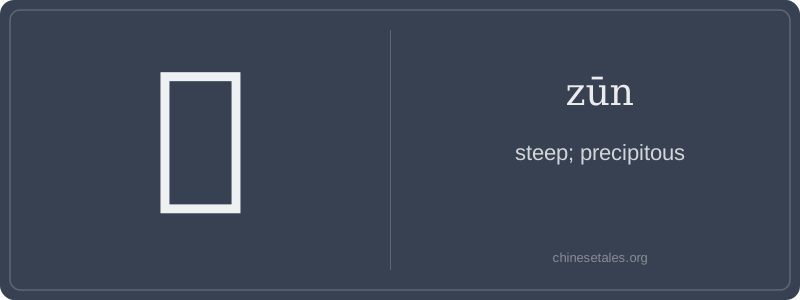
The earliest form of 嶟 appears in seal script (around 3rd century BCE), where it clearly combines 山 (mountain, the radical) on the left with 尊 (zūn, 'revered', 'venerable') on the right. Unlike many characters where the phonetic component is purely sound-based, 尊 here is both phonetic *and* semantic — its original bronze inscription depicted wine vessels on a ritual altar, symbolizing height, solemnity, and unassailable authority. Over centuries, the mountain radical became more stylized, and 尊 simplified from a complex vessel-and-platform glyph into today’s 12-stroke form — yet the towering, reverent connotation remained embedded in the structure.
This duality — physical elevation + moral gravity — shaped 嶟’s literary evolution. In the Classic of Mountains and Seas, it describes peaks so sheer no birds dare nest; by the Tang dynasty, poets like Du Fu used 嶟 to personify mountains as austere sages: '嶟岭自不群' ('The precipitous ridges stand apart, unswayed by the crowd'). The character never meant 'slightly steep' — it was always about extremity, reverence, and isolation. Its visual composition — mountain + venerated vessel — quietly insists: true steepness isn’t just geometry; it’s sacred geometry.
Think of 嶟 (zūn) as the Chinese equivalent of 'cliffhanger' — not the TV trope, but the literal, vertigo-inducing cliff. Its core meaning isn’t just 'steep' — it’s *dangerously* steep, the kind where your hiking boots skid on loose shale and your breath catches in your throat. In classical and literary Chinese, it almost always modifies mountains, gorges, or cliffs — never stairs or ramps. You’ll rarely see it in modern spoken Mandarin; it’s a poetic heavyweight, like calling a hill 'alpine' instead of 'steep'.
Grammatically, 嶟 is an adjective that usually appears before nouns (嶟峰, 嶟崖) or in parallel four-character idioms (如嶟岭崇冈). It doesn’t take degree adverbs like 很 or 非常 — saying '很嶟' sounds archaic or jarringly unnatural, like saying 'very ye olde' in English. Instead, it often pairs with classical verbs: 嶟立 (to stand precipitously), 嶟峙 (to loom sheer and unyielding). Learners mistakenly treat it like common adjectives (高, 陡), but it resists colloquial grammar — it’s a fossilized word, preserved in poetry and geography texts.
Culturally, 嶟 evokes Daoist and Tang dynasty landscape aesthetics — not just topography, but moral austerity. A '嶟峰' isn’t merely tall; it’s morally unassailable, remote, and awe-inspiring. Modern learners’ biggest trap? Confusing it with 俊 (jùn, 'handsome') due to identical pronunciation in some dialects or mishearing — but visually and semantically, they’re galaxies apart. Also, don’t try to use it in daily speech — your friend won’t say '这楼梯太嶟了'; they’ll say '这楼梯太陡了'.