嶞
Character Story & Explanation
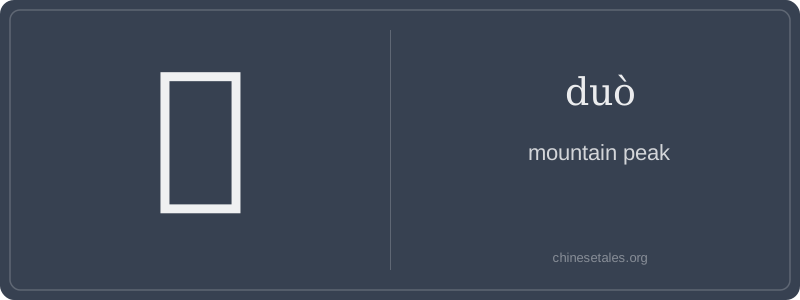
The earliest form of 嶞 appears in bronze inscriptions of the Western Zhou dynasty (c. 1046–771 BCE) as a stylized mountain silhouette with three distinct, jagged summits — not rounded hills, but sharp, vertical projections rising from a base line representing earth. Over centuries, the top ‘mountain’ component (山) solidified into its modern shape, while the lower part evolved from a phonetic-semantic compound: the left side (隋) was originally a variant of 隋 (suí), used here purely for sound (duò), and the right side (阝, the 'hill' radical) reinforced terrain meaning. By the Han dynasty, the structure stabilized into today’s 17-stroke form — a visual echo of geological uplift.
In classical usage, 嶞 acquired ritual gravity. In the *Shījīng* Ode 'Yōng' (Mao #282), it modifies 'mountains of the four directions', signifying peaks so sharply defined they could demarcate cosmic boundaries. Later, Tang poets like Du Fu used 嶞 metaphorically — not for physical height, but for moral or aesthetic rigor: a '嶞峰' was a standard of uncompromising excellence. Its visual narrowness — tall, thin, angular — became inseparable from its semantic weight: precision, exclusivity, and quiet authority.
嶞 (duò) is a poetic, almost archaic character meaning 'a narrow, steep mountain peak' — not just any summit, but one that juts upward with dramatic, knife-edge sharpness. It carries the weight of classical Chinese landscape aesthetics: think mist-wrapped, solitary peaks in Song dynasty ink paintings, not tourist-friendly mountain resorts. You’ll rarely hear it in daily speech; it lives in literary descriptions, historical texts, and poetic couplets where precision and evocative imagery matter more than utility.
Grammatically, 嶞 functions as a noun or adjective, often paired with other mountain-related characters like 岳 (yuè, 'great mountain') or 巉 (chān, 'precipitous'). It doesn’t take measure words like 个 or 座 — instead, it appears in fixed binomes such as 嶞岳 (duò yuè) or 嶞巘 (duò yǎn), where its role is lexical glue: each character contributes texture, not syntax. Learners sometimes try to use it standalone ('the peak is 嶞'), but that’s ungrammatical — it’s never predicative without support. Think of it like English 'crags' or 'spires': evocative nouns that demand context.
Culturally, 嶞 is a quiet relic of pre-Qin geographical terminology — it appears only once in the entire *Classic of Poetry* (*Shījīng*), describing the sacred peaks of the Nine Provinces. Modern learners encounter it mainly in calligraphy practice or classical exams. A common mistake? Confusing it with 峰 (fēng), which is neutral and common — whereas 嶞 implies austerity, antiquity, and literary authority. Using 嶞 in casual chat would sound like quoting Confucius at a coffee shop: technically correct, wildly out of place.