嶝
Character Story & Explanation
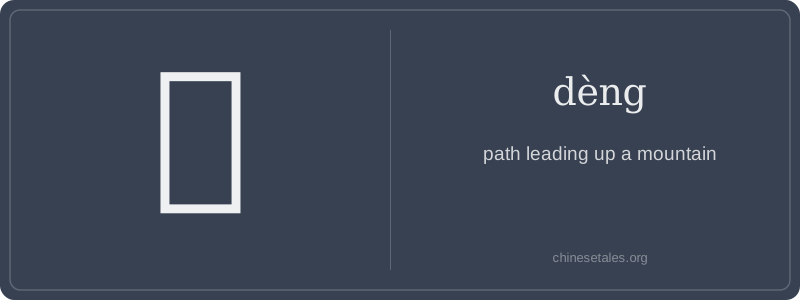
The earliest form of 嶝 appears in seal script (c. 3rd century BCE), where it clearly combines 山 (shān, 'mountain') on the left with 登 (dēng, 'to ascend') on the right — not as a phonetic loan, but as a semantic-phonetic compound (形声字). The left radical 山 anchors the meaning firmly in the mountainous realm, while the right component 登 provides both pronunciation (dēng → later shifted to dèng under tone sandhi influence in compound contexts) and conceptual reinforcement: 登 literally depicts two feet stepping onto a platform — a perfect visual metaphor for ascending. Over centuries, the 登 component simplified: its top 'step' (癶) and bottom 'platform' (豆) gradually fused into today’s compact, angular form with 15 precise strokes.
This character never appeared in oracle bone inscriptions — it emerged later, during the Warring States period, when literati began naming and describing specific terrain features in regional geography texts. In the 12th-century *Yù Hǎi* (Jade Sea), a monumental leishu encyclopedia, 嶝 is defined as 'a narrow, stepped path clinging to cliffs'. Its poetic weight grew in Tang poetry: Wang Wei wrote of 'mist-shrouded 嶝 paths where no voice reaches', using it to contrast human scale against nature’s grandeur. Visually, the character itself mirrors its meaning — the rising stroke of 山 meets the upward thrust of 登, creating a vertical tension that feels like climbing just by looking at it.
Picture a narrow, winding trail snaking up a steep mountainside — not a grand road, but a humble, functional path carved by foot and time. That’s 嶝 (dèng): a poetic, slightly literary word for 'mountain path' or 'ascent route'. It evokes effort, solitude, and quiet persistence — think of a Taoist hermit climbing at dawn, not a tourist on a cable car. Unlike common words like 路 (lù, 'road') or 道 (dào, 'path/way'), 嶝 is rarely used in daily speech; it appears mostly in classical poetry, place names (especially in southern China), and descriptive prose where atmosphere matters more than utility.
Grammatically, 嶝 functions as a noun and often appears with modifiers: 羊肠嶝 (yángcháng dèng, 'sheep-gut path' — i.e., extremely narrow and twisting), or in compounds like 嶝道 (dèngdào). It doesn’t take aspect markers (了, 过) or verbal suffixes — you wouldn’t say *嶝了 or *嶝过. Learners sometimes misread it as dēng (like 登, 'to ascend') due to visual similarity, but that’s a critical error: 登 is a verb meaning 'to climb', while 嶝 is strictly a noun meaning 'the path itself'. Confusing them turns 'I climbed the mountain' into 'I mountain-pathed the mountain' — grammatically nonsensical and semantically absurd.
Culturally, 嶝 carries a subtle Daoist-Buddhist resonance: it suggests a path that is both physical and metaphysical — a journey inward as much as upward. You’ll find it in Tang dynasty landscape poetry and Ming-Qing travel diaries, always paired with mist, pine, stone steps, or silence. Modern usage is rare, so encountering it feels like turning a page in an old scroll — a quiet reminder that Chinese writing preserves layers of sensory and philosophical history in single strokes.