嶙
Character Story & Explanation
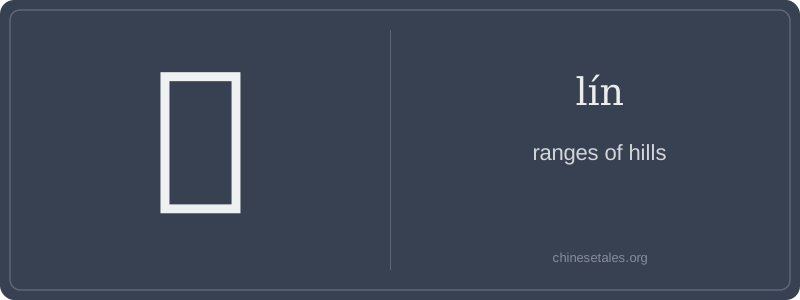
The earliest form of 嶙 appears in seal script (c. 3rd century BCE), where the left side was clearly 山 (shān, ‘mountain’), and the right side resembled 粦 (lín) — itself a pictograph of flickering light over bones (originally depicting ghostly phosphorescence in graveyards). Over centuries, 粦 evolved into the modern phonetic component 麟 (though simplified here to 麟’s top part + 木-like strokes), preserving the ‘lín’ sound while anchoring the meaning to mountains: imagine spectral light dancing across a fractured, rocky escarpment — a vivid, eerie image of terrain that refuses to be smoothed.
This haunting origin stuck: by the Tang and Song dynasties, 嶙峋 appeared repeatedly in poetry and travelogues — Du Fu wrote of ‘嶙峋怪石’ (jagged, strange stones) beside mountain streams, and Su Shi described cliffs as ‘骨立嶙峋’ (skeletal and craggy). The character’s visual duality — mountain + ghost-light — subtly reinforces its core idea: landforms so ancient and eroded they seem to hold memory, even spirit. Its structure literally layers geology (山) with something uncanny and luminous (the 粦 root), making it one of Chinese writing’s most atmospherically charged characters.
嶙 (lín) isn’t just ‘hills’ — it’s the *texture* of hills: jagged, layered, ancient, and quietly imposing. In Chinese, it rarely stands alone; it almost always appears in the reduplicative compound 嶙峋 (lín xún), evoking a landscape that feels alive with geological tension — think weathered cliffs, wind-sculpted rock faces, or the craggy silhouette of mountains at dusk. This isn’t gentle rolling hills (that’s 丘 or 岗); 嶙 carries weight, age, and visual complexity — a word poets reach for when describing resilience or austere beauty.
Grammatically, 嶙 is functionally bound: you’ll almost never see it outside 嶙峋, and even then, it’s usually an adjective modifying nouns (e.g., 嶙峋的山石) or used metaphorically for gaunt, angular human features (e.g., 嶙峋的手骨). Learners sometimes mistakenly treat it as a standalone noun like ‘mountain range,’ but it has no independent noun usage in modern Mandarin — trying to say *‘这座嶙很美’ is ungrammatical and will puzzle native speakers.
Culturally, 嶙峋 reflects a deep aesthetic appreciation for rugged authenticity — think scholar’s rocks (gongshi) displayed in classical gardens: twisted, perforated, unrefined yet profoundly expressive. It’s the antithesis of smooth perfection. A common learner trap? Confusing it with 林 (lín, ‘forest’) due to identical pronunciation — but while 林 evokes lushness and life, 嶙 evokes erosion, endurance, and stark geometry. Its rarity in spoken daily language (it’s literary, poetic, descriptive) means encountering it feels like opening a scroll of Song dynasty landscape painting.