崂
Character Story & Explanation
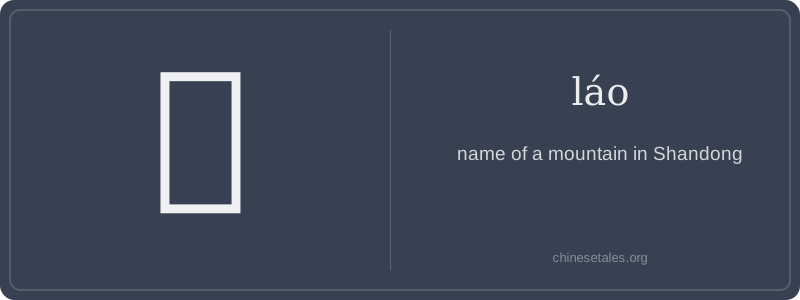
The earliest form of 崂 doesn’t appear in oracle bone inscriptions — it’s a relatively late creation, emerging during the Han dynasty as Chinese writing systematized geographical naming. Its structure is deliberately transparent: 山 on the left (three peaks stylized as three vertical strokes under a horizontal cap) anchors the meaning, while the right side — originally written as 郎 (láng) — was gradually simplified and stylized into today’s 嘏-like shape, retaining just enough visual echo of the original phonetic to signal láo. Stroke by stroke, it evolved from a clear ‘mountain + official title’ compound (as early maps associated mountains with territorial administration) into a compact, 10-stroke emblem — the third stroke of 山 curves gently, the fourth stroke of the right component sweeps down like a winding mountain path, and the final dot lands like a temple roof perched high.
By the Tang and Song dynasties, 崂 had crystallized solely around Láoshān Mountain — famed since the Qin dynasty as a site where Emperor Qin Shi Huang sent alchemists seeking elixirs of immortality. The character itself never acquired metaphorical extensions (unlike 山, which can mean ‘abundance’ or ‘burden’); its meaning stayed geographically tethered. Pu Songling’s 17th-century story ‘Láoshān Taoist’ cemented its cultural resonance — a tale where a lazy scholar learns that true magic isn’t spells, but disciplined practice… echoing the mountain’s own ethos of serene endurance.
崂 (láo) is a proper noun character — not a verb, adjective, or abstract concept, but a geographical anchor: it’s the name of Láoshān Mountain, a sacred Taoist peak near Qingdao in Shandong Province. Visually, it’s a classic ‘mountain + phonetic’ character: the left radical 山 (shān, ‘mountain’) immediately tells you this belongs to the landscape family, while the right component 嘏 (a simplified historical variant of 郎, here serving as a phonetic hint for láo) gives the sound. Unlike common characters like 山 or 水, 崂 appears almost exclusively in place names — never used alone to mean ‘mountain’ or ‘peak’. You’ll never say ‘I climbed a láo’ — only ‘I hiked Láoshān’.
Grammatically, it’s inert: no inflections, no derivations, no standalone usage. It only lives inside compounds like 崂山 (Láoshān), 崂山道士 (Láoshān Taoist — famous from Pu Songling’s classic ghost story), or as part of administrative terms like 崂山区 (Láoshān District, a real urban district in Qingdao). Learners sometimes misread it as láo (correct) but then overgeneralize — trying to use it as a generic word for ‘steep mountain’, which native speakers instantly flag as unnatural. It’s not descriptive; it’s commemorative — like saying ‘Everest’ instead of ‘tall mountain’.
Culturally, 崂 carries quiet weight: it evokes mist-wrapped cliffs, ancient temples, and Daoist immortals brewing tea among pine trees. Its rarity in daily speech means encountering it feels like spotting a rare bird — a sign you’ve entered regional history or literary terrain. Mistake alert: don’t confuse it with similar-looking characters like 嘈 (cáo, ‘noisy’) or 劳 (láo, ‘toil’) — their meanings and radicals are worlds apart, even if they share the same pronunciation.