嵚
Character Story & Explanation
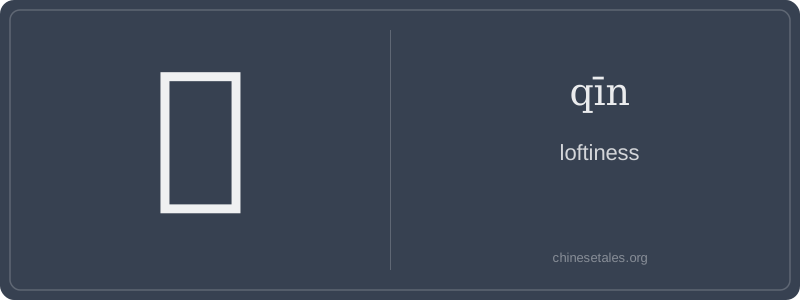
The character 嵚 first appeared in seal script during the Warring States period, evolving from a vivid pictograph: two mountain-like peaks (山) stacked vertically, with a strong, angular stroke cutting through the center — representing a sheer, unbroken ridge line. Over time, the left side solidified into 山 (mountain radical), while the right side transformed from a stylized ‘steep slope’ glyph into 钦 (qīn), borrowed here purely for its sound, not its meaning (钦 means ‘to respect’ — a later phonetic loan). The modern form retains that imposing verticality: 山 on the left anchoring the idea of terrain, and 钦 on the right lending both pronunciation and a subtle echo of reverence.
This visual duality shaped its semantic journey: from literal topography (‘towering mountain’) to metaphorical elevation (‘lofty virtue’, ‘exalted status’). In the 3rd-century text *Shuǐ Jīng Zhù* (Commentary on the Water Classic), 嵚 appears describing the ‘lofty, jagged cliffs of the Yangtze Gorges’ — already imbued with awe, not mere geography. By the Tang dynasty, poets like Li Bai used 嵚崟 to evoke spiritual aspiration: mountains weren’t just landforms but vertical pathways to transcendence. The character’s very shape — tall, narrow, unyielding — mirrors the quality it names.
嵚 (qīn) is a poetic, almost antique word that evokes the awe-inspiring verticality of mountains — not just height, but *loftiness*: grandeur, solemn elevation, and quiet majesty. It’s rarely used in daily speech or modern media; instead, it lives in classical poetry, literary descriptions, and formal landscape writing. Think of it as the Chinese equivalent of 'sublime' or 'austere eminence' — less about measurement and more about emotional resonance. You won’t hear it in weather reports or subway announcements, but you’ll feel its weight in a Tang dynasty poem describing Mount Tai at dawn.
Grammatically, 嵚 functions almost exclusively as an adjective, typically in reduplicated form 嵚崟 (qīn yín) or paired with other mountain-related characters like 嵚峨 (qīn é). It never stands alone as a verb or noun, and it doesn’t take aspect particles (了, 过, 着) — a common learner mistake. Using 嵚 without its customary collocations (e.g., saying *‘这座山很嵚’*) sounds jarringly unnatural, like saying ‘this mountain is sublime’ without context in English. Native speakers instinctively pair it: 嵚崟、嵚峨、嶔崎 — always doubling or combining to amplify the sense of towering, unbroken ascent.
Culturally, 嵚 reflects the deep Daoist and Confucian reverence for mountains as moral and cosmic anchors — places where heaven meets earth, where sages retreat and immortals dwell. Its rarity today makes it a linguistic fossil: still legible, still beautiful, but reserved for moments when ordinary words fail. Learners often misread it as qīn (like 亲) and assume familial meaning — a charming but total semantic derailment. Remember: this qīn belongs to peaks, not parents.