嶓
Character Story & Explanation
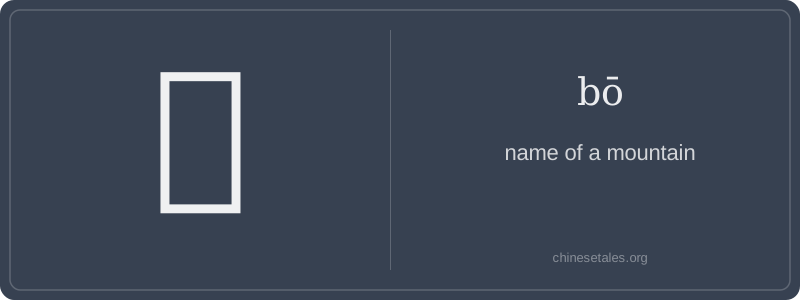
The earliest form of 嶓 appears not in oracle bones but in late Han steles and Tang stone inscriptions—a highly stylized compound: the radical 山 (shān, 'mountain') stacked firmly atop 波 (bō, 'wave'), though crucially *not* as a phonetic loan. Visually, it’s a mountain crowned by undulating lines suggesting wind-swept ridges or mist-wrapped contours—not water. Over centuries, the upper 波 simplified: its 氵 (water) radical shrank into three dots, and the 'piě-nà' strokes of 皮 hardened into angular, rocky forms—resulting in today’s top component, which looks like a compressed, craggy silhouette.
This evolution reflects its function: not descriptive, but commemorative. Tang poets like Du Fu referenced 嶓山 in verses praising Sichuan’s frontier grandeur, while Song geographers noted it as a boundary marker between Chengdu’s western prefectures. Unlike generic mountain characters, 嶓 never generalized—it resisted semantic drift. Its visual weight (16 strokes!) signals importance: each stroke mimics a cliff face or path switchback, making the character itself a cartographic glyph. To ancient scribes, writing 嶓 wasn’t naming terrain—it was inscribing authority onto the land.
Imagine you’re hiking deep in Sichuan’s mist-shrouded peaks, and your local guide points to a jagged ridge veiled in cloud—'That’s Bō Shān,' he says, voice hushed with reverence. This isn’t just any mountain: 嶓 (bō) is the name of a specific, historically significant peak near Chengdu, mentioned in Tang dynasty poetry and Ming-era gazetteers. It carries no generic meaning—no 'mountain' or 'peak' sense on its own—only this one proper geographical identity. Think of it like 'Ben Nevis' in English: pronounceable, untranslatable, and tied irrevocably to place.
Grammatically, 嶓 appears only as part of a proper noun—never standalone, never in compounds like 'mountain range' or 'climb'. You’ll never say 'I climbed 嶓'; you’ll say 'I visited 嶓山 (Bō Shān)'. Learners sometimes mistakenly treat it as a free morpheme or confuse it with common mountain-related characters like 山 or 峰—but 嶓 has zero semantic flexibility. Its pinyin is fixed: bō (first tone), never bó or bò. Mispronouncing it breaks the name’s historical continuity.
Culturally, 嶓 embodies China’s deep-rooted toponymic tradition: characters created solely for sacred or administratively vital places, preserved across dynasties even when their pronunciation shifted elsewhere. Modern dictionaries list it under 'rare geographical terms', and few native speakers outside Sichuan recognize it without context. The biggest trap? Assuming it’s a variant of 波 (bō, 'wave') because of sound—yet they share no etymological link. This character doesn’t ripple; it rises—steep, silent, and singular.