嶒
Character Story & Explanation
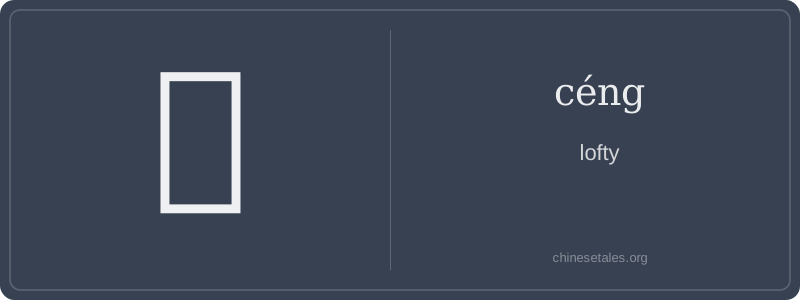
The character 嶒 first appeared in seal script during the Warring States period, evolving from a vivid pictograph: two mountain peaks (山) stacked vertically, with a ‘steep cliff’ element (曾, originally depicting a layered, overhanging rock face) beneath — together visualizing a mountain so high its slopes seem to rise in successive, dramatic tiers. Over centuries, the upper 山 radical stabilized, while the lower 曾 simplified from a complex ‘rock strata’ glyph into today’s familiar form — preserving the core idea of *ascending grandeur through layered elevation*.
By the Han dynasty, 嶒 was already entrenched in literary geography: Sima Qian’s *Records of the Grand Historian* uses it to describe the ‘lofty, awe-stilling presence’ of sacred peaks in ritual texts. Its meaning never drifted toward mere ‘height’ — it retained its connotation of *sublime, morally resonant elevation*, distinguishing it from neutral terms like 高. Even in Tang poetry, when Li Bai wrote of ‘mountains 嶒然耸立’, he wasn’t measuring altitude — he was invoking a metaphysical verticality, where landscape mirrors virtue. That visual logic — mountains built *upon mountains* — remains embedded in every stroke.
At first glance, 嶒 (céng) feels like a whisper from classical Chinese poetry — it doesn’t shout ‘tall’ or ‘high’ like 高 (gāo) or 伟 (wěi); instead, it evokes *loftiness*: the serene, almost spiritual elevation of mountains piercing mist, or a scholar’s unshakeable moral stature. It’s not about physical height alone, but vertical dignity — quiet, enduring, awe-inspiring. You’ll rarely hear it in daily speech; it lives in literary descriptions, classical allusions, and poetic place names (like Mount Song’s ancient epithet).
Grammatically, 嶒 is almost exclusively an adjective — and a rare one at that. It never stands alone colloquially; you won’t say ‘this building is 嶒’. Instead, it appears in fixed, elegant compounds like 嶒峨 (céng’é), meaning ‘towering and majestic’, often modifying natural features: 嶒峨的山峰 (céng’é de shānfēng). It can also function as a literary adverb — e.g., 嶒然 (céng rán), ‘loftily, with elevated bearing’ — describing how a person holds themselves in moral or aesthetic authority.
Learners often misread it as céng (like 层, ‘layer’) due to identical pinyin — but this 嶒 has zero semantic link to layers or levels. Worse, they may confuse it with the far more common 曾 (céng, ‘already’ or ‘once’), which shares tone and sound but differs utterly in meaning and origin. The biggest trap? Assuming it’s usable in modern spoken contexts — it isn’t. Using 嶒 outside poetic, historical, or highly formal writing will sound archaic or unintentionally humorous, like quoting Shakespeare to order coffee.