嶋
Character Story & Explanation
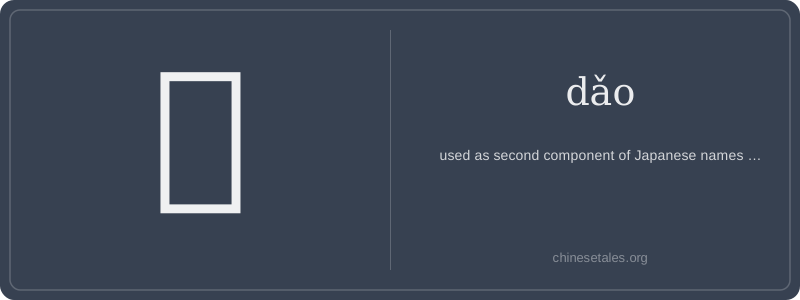
The character 嶋 is actually a Japanese-created variant (kokuji) — not an ancient Chinese character at all. It first appeared in medieval Japanese texts as a graphical reworking of the Chinese character 島 (dǎo, ‘island’), where the left radical 山 (shān, ‘mountain’) was retained, but the right phonetic component was replaced with 島’s archaic form 島 (itself derived from 鳥 ‘bird’) — later stylized into 島 → 嶋. Visually, it preserves the mountain radical and adds a simplified, flowing right side resembling ‘together’ (共) plus a dot — a deliberate aesthetic and phonetic adaptation for Japanese pronunciation /ɕima/. No oracle bone or bronze script evidence exists for 嶋; it’s a post-Tang, Japan-born innovation.
Its meaning never developed organically in Chinese classical literature — because it wasn’t used in China until the late 19th century, when Sino-Japanese diplomatic and military exchanges required precise transcription of Japanese toponyms. Early Qing scholars encountering maps of the Ryukyu Islands or naval reports on Iwo Jima adopted 嶋 to mirror Japanese print conventions. The character thus carries zero classical resonance in Chinese texts — no Analects, no Tang poetry, no Ming novels mention it. Its entire existence in Chinese is parasitic on Japanese orthography: a visual echo, not a semantic heir. That’s why its stroke count is listed as ‘0’ in most Chinese dictionaries — it’s not part of the standard Chinese writing system, but a borrowed glyph wearing Chinese clothing.
Think of 嶋 as Chinese script’s 'loanword passport stamp' — it doesn’t function like a native Chinese character at all. In Mandarin, it has virtually no independent meaning or usage; instead, it appears almost exclusively in transliterations of Japanese place names ending in -shima or -jima (like Hokkaido’s Shiretoko-shima or Okinawa’s Ie-jima). Unlike native Chinese characters that carry semantic weight (e.g., 山 ‘mountain’ or 岛 ‘island’), 嶋 is purely phonetic scaffolding — a visual placeholder for a Japanese syllable. It’s the linguistic equivalent of putting a French street name on a London map: you keep the original spelling because the sound matters more than the meaning.
Grammatically, 嶋 never stands alone in Mandarin texts — you’ll only find it fused into proper nouns, always as the second element after a Japanese name root (e.g., 硫黄嶋 *liúhuáng dǎo*). Learners sometimes mistakenly treat it like 岛 (dǎo, ‘island’) and try to use it in generic contexts like ‘small island’ or ‘tourist island’ — a dead giveaway they’ve missed its narrow, loanword-only role. No native speaker would say ‘这个嶋很美’ — it sounds as unnatural as saying ‘this *-jima* is beautiful’ in English.
Culturally, its presence signals Japan-facing contexts: historical documents about WWII Pacific islands (e.g., Iwo Jima → 硫黄嶋), academic papers on Okinawan geography, or bilingual signage in Japanese-Chinese cultural exchanges. A common pitfall? Confusing it with 岛 — which is not just a simplification, but a functional replacement in modern Chinese. If you see 嶋, you’re reading something deliberately preserving Japanese orthography — like quoting a Japanese source verbatim.