嶅
Character Story & Explanation
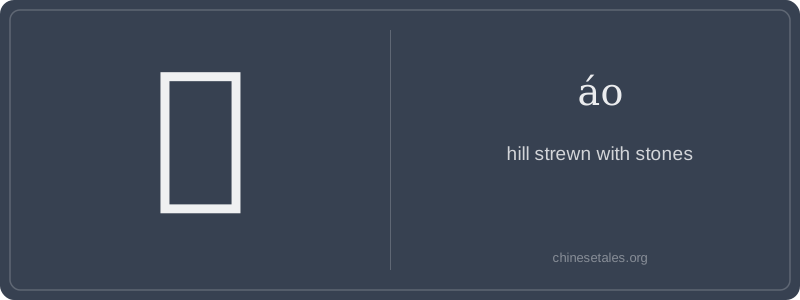
The earliest form of 嶅 appears in Han dynasty seal script, not oracle bones — it’s relatively late in the character timeline. Visually, it’s a masterclass in semantic stacking: the top is 山 (shān, ‘mountain’), unmistakable even in ancient forms; the bottom is 敖 (áo), originally a pictograph of a person standing on a raised platform, later evolving to mean ‘to wander’ or ‘to loiter’, but here repurposed phonetically *and* semantically — suggesting restless, scattered energy. Over centuries, the 山 radical stabilized, while 敖 simplified from a complex figure with arms and legs into today’s streamlined form with 10 strokes beneath.
This dual-layer structure tells a story: a mountain *animated* by stone — not passive, but actively strewn, chaotic, unrefined. In the 6th-century Commentary on the Water Classic, 嶅 appears describing the craggy banks of the Wei River, where boulders tumbled down slopes after floods. Later, Li Daoyuan notes how such terrain resisted cultivation and sheltered bandits — giving 嶅 subtle connotations of wildness and marginality. Its visual weight — 13 strokes total — mirrors its semantic density: every line feels like a rock tumbling into place.
Picture a windswept, rugged hillside scattered with jagged rocks — that’s the visceral feeling of 嶅 (áo). It’s not just any hill; it’s one defined by its stony chaos, evoking raw, untamed terrain. In classical Chinese, 嶅 appears almost exclusively in literary or poetic contexts — think Tang dynasty landscape poetry or Ming-Qing travel essays — where precise geomorphic vocabulary mattered. You won’t hear it in daily speech; it’s a ‘pen-and-ink’ character, reserved for writing, not talking.
Grammatically, 嶅 functions as a noun (rarely as a modifier) and almost never stands alone. It’s nearly always embedded in compound words like 嶅崿 or 嶅嵂 — never used bare like 山 or 岭. Learners sometimes misread it as áo (which is correct), but then wrongly assume it’s interchangeable with 峨 (é, ‘towering’) or 岬 (jiǎ, ‘cape’) — a classic trap, since those characters evoke height or coastal features, not stony topography. Also, don’t try to use it in modern spoken descriptions: saying ‘这座山很嶅’ will sound archaic or even nonsensical to most native speakers.
Culturally, 嶅 reflects ancient China’s deep attention to landform nuance — a single character capturing *stone-littered elevation*, distinct from barren hills (岤), volcanic cones (峰), or forested ridges (岭). Its rarity today makes it a linguistic fossil: still alive in dictionaries and classical texts, but dormant in conversation. Mistake it for a common word at your peril — it’s less a tool and more a brushstroke in the ink-painting of classical geography.