嵝
Character Story & Explanation
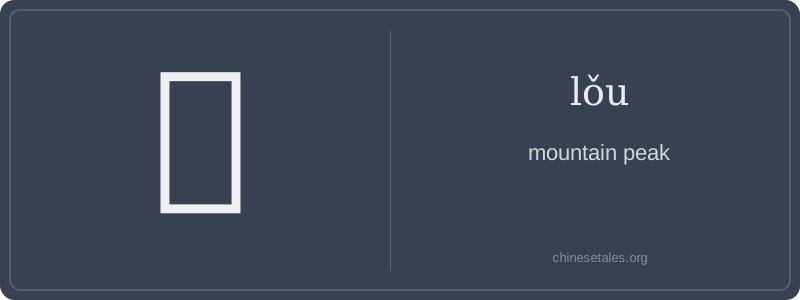
The earliest form of 嵝 isn’t found in oracle bones, but emerges clearly in seal script (c. 3rd century BCE) as a compound: the radical 山 (shān, ‘mountain’) on the left, and a phonetic component 受 (shòu, ‘to receive’) on the right — though here, 受 is heavily stylized, its top stroke curving like a crest, its lower strokes suggesting layered rock strata. Over centuries, 受 simplified into the modern 受-like shape (but note: it’s not the same character!), and the whole structure compacted — the three horizontal strokes of 山 became clean and angular, while the right side condensed into two diagonal strokes and a final hook, evoking a sharp, upward thrust.
This visual evolution mirrors its semantic journey: from a generic ‘mountain-related sound symbol’ to a highly specific geomorphological term. By the Tang and Song dynasties, 嵝 appeared in local gazetteers and poetry describing southern China’s jagged coastal hills — notably in Du Fu’s lesser-known travel notes and in Ming dynasty maps of Fujian’s granite peaks. The character’s tight, ascending stroke order (ending with a decisive downward hook) physically enacts the act of rising to a narrow summit — a rare case where calligraphic motion reinforces meaning.
Imagine you’re hiking the mist-shrouded peaks of Shandong’s Mount Tai at dawn — not the main summit, but a lesser-known, craggy subsidiary peak where the wind howls and eagles circle. That distinct, sharply defined, slightly isolated mountain crest? That’s a 嵝 (lǒu). It doesn’t mean ‘mountain’ in general (that’s 山), nor ‘valley’ (谷) or ‘ridge’ (岭). It’s specifically a *prominent, conical, often solitary peak* — usually smaller than a main summit but visually striking and topographically self-contained.
Grammatically, 嵝 is almost always a noun and rarely appears alone; it’s embedded in place names (like 鹤嵝山 Hèlǒu Shān) or poetic descriptions. You won’t say ‘I climbed a lǒu’ — instead, it’s part of a proper noun or paired with classifiers like 座 (zuò): 一座嵝 (yī zuò lǒu). Learners sometimes misread it as lóu (like 楼 ‘building’) — a fatal slip, since that changes everything. Also, it’s never used metaphorically (unlike 峰 ‘peak’ which can mean ‘height of achievement’); 嵝 stays stubbornly geographical and concrete.
Culturally, 嵝 is a quiet character — unflashy, regionally rooted (especially in Jiangsu, Zhejiang, and Fujian dialects and toponyms), and beloved by poets and local historians for its precise, almost tactile sense of verticality. Its rarity outside place names means encountering it feels like spotting a rare bird: unexpected, rewarding, and deeply local — a reminder that Chinese has hundreds of finely tuned words for landscape features English bundles under ‘hill’ or ‘peak’.