嵺
Character Story & Explanation
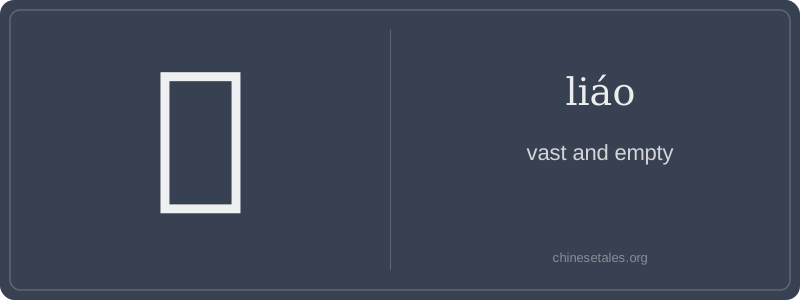
The earliest attested form of 嵺 appears in Han dynasty steles and late clerical script—not oracle bones or bronze inscriptions, since it’s a relatively late compound character. Visually, it fuses 山 (shān, 'mountain', the radical) on the left with 尞 (liáo, a phonetic component meaning 'to ascend high' or 'to light a fire atop a platform') on the right. 尞 itself combines 火 (fire) under 毌 (a variant of 母, suggesting containment or origin), evoking ritual ascent and luminous height. Over time, the fire element simplified, and the right side stabilized into 尞—retaining its soaring, elevated connotation.
This fusion is brilliant: mountain + ascension = a landscape so vast it seems to rise *into* emptiness itself. By the Tang dynasty, poets like Li Bai and Du Fu used 嵺 in phrases like 嵺廓 to evoke cosmic spaciousness—sky unbroken by cloud, plains stretching beyond horizon, silence so deep it hums. The character doesn’t depict void directly; it *performs* void through vertical lift and lateral expanse—its very structure invites the eye upward and outward, mirroring the feeling it names.
Think of 嵺 (liáo) as the Chinese equivalent of the English word 'vastness'—not just big, but deeply empty, resonant, and almost spiritual in its scale, like standing alone at dawn in the Grand Canyon while mist swirls silently across miles of canyon walls. It evokes a hushed, poetic emptiness—not barren, but full of quiet possibility. In classical Chinese, it’s almost never used alone; it appears in fixed literary compounds like 嵺廓 (liáo kuò), describing boundless, serene openness—often of sky, wilderness, or the mind.
Grammatically, 嵺 is strictly literary and adjectival: you won’t find it in spoken Mandarin or modern news headlines. It functions like an elevated descriptor—always paired, never predicative (*not* 'the field is 嵺'), and never used with 是 or 很. A learner might mistakenly insert it into casual speech ('这个房间很嵺')—but that would sound as jarringly archaic as saying 'verily' in a text message. Its power lies in restraint: it only breathes in parallelism, rhythm, and classical cadence.
Culturally, 嵺 carries Daoist and Chan Buddhist echoes—suggesting emptiness not as lack, but as fertile ground for insight. Modern readers may misread it as a variant of 寥 (also liáo, meaning 'sparse' or 'desolate'), but 嵺 is rarer, more atmospheric, and visually distinct: its mountain radical (山) anchors the emptiness in landscape, not loneliness. Confusing the two flattens centuries of poetic nuance—like swapping 'ethereal' for 'lonely' in a Rilke poem.