岚
Character Story & Explanation
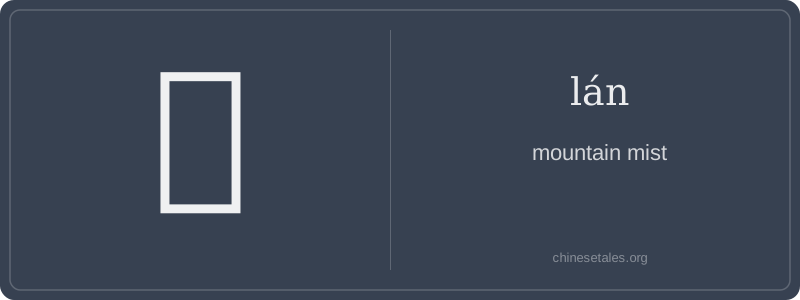
The earliest form of 岚 appears in seal script (not oracle bone, as it’s a later compound character), composed of 山 (mountain) on the left and 风 (wind) on the right — but over centuries, 风 simplified and stylized into the top-right component that looks like 三 + 丶 (three horizontal strokes plus a dot). This wasn’t arbitrary: ancient scribes visualized mountain mist as wind-born vapor swirling among peaks — a dynamic interplay of air and elevation. The seven strokes encode this duality: three horizontal lines (the mist layers), a vertical stroke (the mountain ridge), and two supporting strokes (the wind’s movement).
By the Tang dynasty, 岚 had shed its literal 'wind + mountain' reading and crystallized into a standalone poetic term for the luminous, soft-edged mist unique to highland terrain — especially in southern China’s humid, tea-growing hills. Classical poets used it to imply mood rather than meteorology: in Wang Wei’s '鹿柴' (Deer Enclosure), though 岚 doesn’t appear, its spirit permeates lines like '空山不见人' ('Empty mountains — no people seen'), where silence and mist merge. Visually, the 山 radical anchors it to geography, while the fluid upper part whispers motion — a perfect visual haiku in one character.
Think of 岜 (lán) as Chinese poetry’s version of a misty Monet water lily painting — not just 'mist', but the hushed, shimmering, almost sentient veil that clings to mountain slopes at dawn. In Chinese, it evokes stillness, transience, and quiet grandeur: never plain fog (雾 wù), which feels damp and mundane, but 岚 — ethereal, aesthetic, and deeply literary. It’s almost never used alone; you’ll find it only in compounds or poetic phrases, like a rare spice added for aroma, not bulk.
Grammatically, 岚 behaves like a noun — but a delicate, uncountable one. You won’t say *'three 岚'* or *'a 岚'*; instead, it appears in fixed expressions: 山岚 (shān lán, 'mountain mist'), 晓岚 (xiǎo lán, 'dawn mist'), or as a poetic element in names (e.g., personal names like 晓岚, place names like 岚山). Learners often mistakenly treat it like a verb or try to use it colloquially — but native speakers would raise an eyebrow if you said '今天有岚' ('There’s 岚 today'); it sounds like quoting Tang dynasty verse at the bus stop.
Culturally, 岚 carries Daoist and Chan Buddhist resonance — mist as metaphor for impermanence and obscured truth. It appears in classical poems by Wang Wei and Li Bai, always suggesting mystery, retreat, or subtle revelation. A common learner trap? Confusing it with 兰 (lán, orchid) — same sound, wildly different meaning and radical. Remember: 山 on the left = mountains are involved; 兰 has 艹 (grass) — so it’s about flowers, not fog.