嵎
Character Story & Explanation
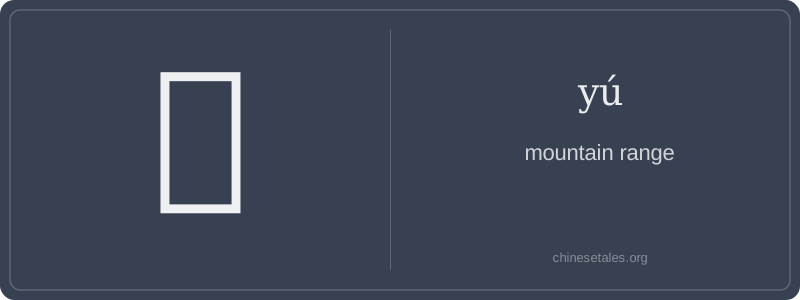
The earliest form of 嵎 appears in bronze inscriptions as a combination of 山 (shān, mountain) on the left and 偶 (ǒu, originally 'pair' or 'companion') on the right — but crucially, the right side evolved from a pictograph depicting two people standing side-by-side on a slope, visually reinforcing the idea of repeated, connected elevations. Over centuries, the 'two people' simplified into 偶’s phonetic component, while 山 retained its unmistakable three-peak shape. By the seal script era, the character had stabilized into its modern structure: 山 radical anchoring the meaning, and 偶 providing both sound (yú shares phonetic ancestry with 偶 in Old Chinese) and conceptual weight — suggesting duality, repetition, continuity.
This visual logic deepened its semantic role: not just 'a mountain', but 'mountains in sequence' — a range defined by recurrence and linkage. In the Classic of Poetry (Shījīng), 嵎 appears in phrases like '嵎阿' (yú ā), evoking sheltered, winding mountain valleys where rivers bend and people dwell quietly. Later, in Tang dynasty landscape poetry, it became shorthand for the gentle, layered horizons favored by literati painters — never jagged or violent, always harmonious and extended. Its form literally holds mountains *together*, making it one of Chinese writing’s most elegant cartographic metaphors.
At first glance, 嵎 (yú) feels like a quiet mountain whisper — not the towering, dramatic peaks of 泰山 (Tài Shān), but the long, undulating spine of a range stretching into mist. Its core meaning is 'mountain range' or 'mountainous terrain', evoking continuity and breadth rather than height or singularity. You’ll rarely see it alone in modern speech; it’s a literary and geographical fossil — most at home in classical poetry, place names (like the ancient Yú Mountains in Shandong), or formal geographic descriptions. Think of it as the Chinese equivalent of 'cordillera' in English: precise, dignified, and slightly archaic.
Grammatically, 嵎 functions almost exclusively as a noun, often embedded in compound nouns or poetic binomes. It doesn’t take aspect markers (了, 过) or pluralizers (们); you won’t say *嵎了 or *嵎们. Instead, it appears in fixed structures like 崎岖嵎巘 (qí qū yú yǎn — rugged, undulating mountain ranges) or paired with other topographic characters for rhythmic effect. Learners sometimes misread it as yǔ (like 雨) due to tone confusion — but yú is always second tone, steady and rising like a ridge line.
Culturally, 嵎 carries a subtle connotation of remoteness and seclusion — in classical texts, ‘the far corners of the mountains’ (嵎角) symbolized the edge of civilization, where sages retreated or exiles were sent. Modern learners rarely encounter it outside advanced reading, so overusing it sounds oddly ornate — like describing your local hill as 'a majestic cordillera'. Its rarity makes it a delightful discovery, not a workhorse — treat it like a rare bird call: listen for it in poetry, don’t try to whistle it daily.