嵄
Character Story & Explanation
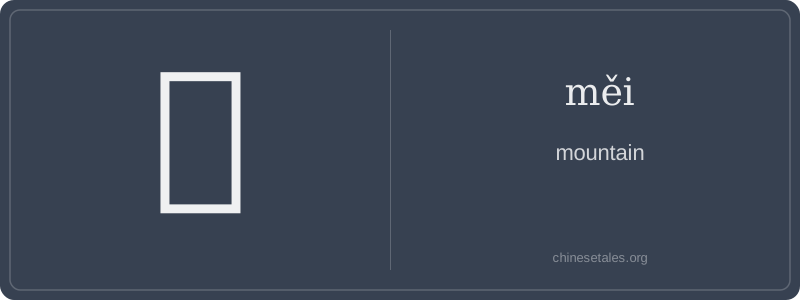
The earliest form of 嵄 appears in seal script (not oracle bone — it’s too late for that), where it clearly combines 山 (shān, ‘mountain’) on the left with 每 (měi, ‘each; every’) on the right. The left side is unmistakably the three-peaked mountain radical — stable, grounded, iconic. The right side, 每, was already a phonetic component by the Han dynasty, lending the pronunciation měi. Visually, it’s a mountain that ‘recurs’ or ‘appears repeatedly’ — perhaps evoking a range of peaks, or the ever-present, cyclical majesty of high terrain.
This character was formally cataloged by Xu Shen in the Shuōwén Jiězì as ‘a lofty mountain’ (gāo shān yě), distinct from common shān in degree and tone. Unlike shān, which could mean any hill or rise, měi implied elevation, grandeur, and remoteness — think sacred peaks like Mount Heng or Kunlun in early Daoist cosmology. Its usage peaked in Northern and Southern Dynasties poetry, then faded from vernacular use, surviving only in fixed compounds and scholarly glosses — a quiet testament to how Chinese preserves semantic nuance across millennia, even when daily speech moves on.
Imagine you’re hiking deep in the mist-shrouded peaks of southern China, and your local guide points to a jagged, pine-draped ridge and says, 'That’s not just any mountain — that’s a měi.' You blink. Wait — isn’t ‘mountain’ just shān? Yes… but měi is something else entirely: a rare, literary, almost poetic synonym for ‘mountain’, preserved like a fossil in classical texts and place names. It carries the weight of antiquity — not functional, not conversational, but evocative, solemn, and slightly mystical.
Grammatically, měi almost never stands alone in modern speech or writing. You won’t say ‘I climbed a měi’ — it doesn’t work that way. Instead, it appears embedded: in ancient poetry (e.g., ‘měi yún’ — ‘mountain clouds’), in historical toponyms (like the now-archaic Měi Shān), or as part of compound words where its presence signals elevated diction. Learners often mistakenly treat it like shān — trying to use it as a free noun — which instantly sounds archaic or comically overwrought, like saying ‘hath’ instead of ‘has’ at a coffee shop.
Culturally, měi is a linguistic relic — a whisper from the Shuōwén Jiězì (121 CE), where Xu Shen defined it as ‘a high mountain’. Its survival is largely due to calligraphers, poets, and geographers who kept it alive in inscriptions and regional names. Today, encountering měi feels like finding a sealed scroll in a library basement: beautiful, meaningful, and utterly out of everyday circulation — which makes using it correctly a subtle mark of deep literacy.