嵂
Character Story & Explanation
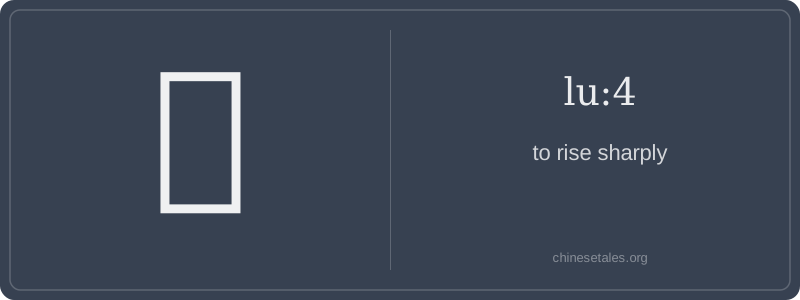
The earliest form of 嵂 appears in Han dynasty steles, not oracle bones — it’s a relatively late creation. Visually, it’s a masterclass in semantic-phonetic design: the left side is 山 (shān, ‘mountain’), unmistakably anchoring it to terrain; the right side is 吕 (lǚ), originally two stacked ‘mouths’ 口口, but here repurposed purely for sound — though cleverly, those two ‘mouths’ evolved into parallel vertical strokes, echoing twin cliff faces. Over centuries, the mountain radical grew more stylized, while 吕 tightened into two clean, upright lines — like twin pillars thrusting skyward from bedrock.
This visual duality — stable base + paired verticals — directly encodes its meaning: not gentle ascent, but a *dual-rising*, sharp and symmetrical, like twin peaks splitting the horizon. In classical texts like Liu Zongyuan’s landscape essays, 嵂 appears in phrases like ‘嵂然孤峙’ (lù rán gū zhì) — ‘rising sharply and alone’ — evoking solitary, defiant grandeur. Its rarity today isn’t decline, but preservation: it’s held in reserve for moments when ordinary words like 高 (gāo) or 耸 (sǒng) lack that precise, stony punch.
Imagine standing at the base of a sheer cliff — not just tall, but *jarringly* vertical, as if the mountain itself gasped and shot upward in one breath. That’s 嵂 (lù): not mere ‘height’, but the visceral, almost violent sensation of something rising *sharply*, abruptly, with jagged energy. It’s poetic, rare, and deeply visual — you’ll rarely hear it in daily chat, but you’ll feel its power in classical poetry or modern literary descriptions of landscapes or emotions.
Grammatically, 嵂 is almost always used as a verb in literary contexts, often in compound verbs like 嵂起 (lù qǐ) or 嵂然 (lù rán). It never stands alone as a single-syllable verb in modern speech — trying to say ‘the hill 嵂s’ would sound archaic or jarring. Instead, it appears in set phrases: 嵂起 like a sudden spine of rock; 嵂然耸立 like a defiant tower. Its tone (4th) mirrors that abrupt drop after the rise — a sonic echo of its meaning.
Culturally, learners often misread 嵂 as ‘lush’ or ‘green’ because of the 山 (mountain) radical and the phonetic component 吕 (lǚ), which looks like two stacked mouths — but no! It has zero connection to vegetation or speech. The biggest trap? Confusing it with 屡 (lǚ, ‘repeatedly’) or 峦 (luán, ‘undulating peaks’). Remember: 嵂 is *sharpness*, not repetition or soft curves — it’s the knife-edge of elevation, not the rhythm of recurrence.