崮
Character Story & Explanation
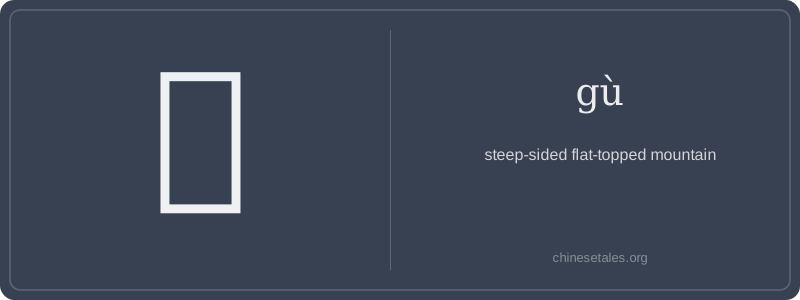
The earliest form of 崮 appears in Han dynasty seal script, not oracle bones — it’s relatively young among Chinese characters. Visually, it’s a masterclass in semantic-phonetic design: the left 山 clearly depicts three jagged peaks (the traditional mountain radical), while the right 古 evolved from an ancient pictograph of a mouth (口) beneath a stylized 'ten' (十), representing 'past generations' — later simplified into today’s 古. In 崮, this 古 was borrowed *only* for its sound (gǔ → gù), but its presence adds gravitas: imagine a mountain so immovable, it feels older than history itself.
By the Tang and Song dynasties, 崮 appeared in local gazetteers describing Shandong’s unique mesas — flat summits rising abruptly from plains, formed by volcanic rock resistant to erosion. Classical poets rarely used it (too regional), but geomancers and cartographers did, treating it as a technical term. Its visual structure reinforces meaning: the 山 radical grounds it in nature, while 古’s angular strokes mirror the sheer, unyielding cliffs surrounding the flat top — every line feels like a contour map carved in ink.
Think of 崮 (gù) as Chinese geography’s version of a geological inside joke: it doesn’t mean just any mountain — it’s *the* mountain that looks like a giant stone table balanced on steep cliffs. The radical 山 (shān, 'mountain') anchors its meaning, while the right side 古 (gǔ, 'ancient') isn’t just phonetic — it subtly hints at timelessness, as if these flat-topped peaks have stood unchanged since antiquity. You’ll almost never see 崮 used alone; it’s a proper-noun specialist, appearing only in specific place names — especially in Shandong Province, where real-life gù mountains dot the landscape like ancient sentinels.
Grammatically, 崮 functions exclusively as part of a compound noun — never as a verb, adjective, or standalone noun. You won’t say 'a gù' or 'very gù'; instead, you’ll encounter it in names like 崮山 (Gù Shān) — much like saying 'Mount Fuji' rather than 'a fuji'. Learners sometimes try to force it into descriptive phrases ('steep flat mountain'), but that’s ungrammatical and confusing. It’s not a category — it’s a *proper name marker* for a very particular landform.
Culturally, 崮 reflects how deeply Chinese language encodes local topography: this character exists because the terrain of southern Shandong is so distinctive that it earned its own logograph. Western learners often misread 古 as 'old' and assume the character means 'ancient mountain' — but no: 古 here is purely phonetic (gù ≈ gǔ), though the visual echo of 'ancient' adds poetic resonance. Also, don’t confuse it with generic mountain words like 峰 (fēng, 'peak') or 岭 (lǐng, 'ridge') — 崮 is geographically precise, not metaphorical.