岽
Character Story & Explanation
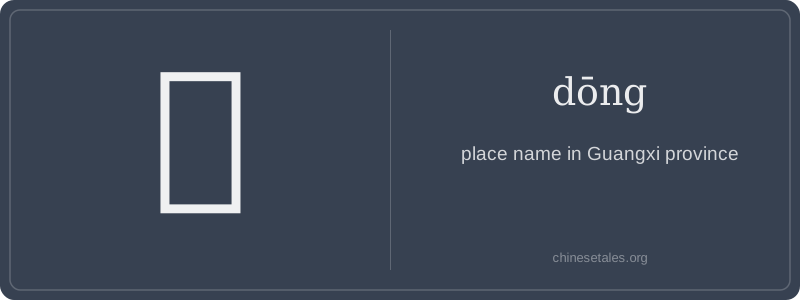
The earliest form of 岽 is unknown in oracle bone or bronze inscriptions — it’s a relatively late creation, likely Song or Ming dynasty, born from the need to transcribe a local Zhuang-language place name into Chinese characters. Its structure is transparently phono-semantic: 山 (shān, mountain radical) anchors its geographic essence, while 东 (dōng) serves solely as a phonetic hint for the local pronunciation — not the Mandarin word for ‘east’. Stroke-by-stroke, it’s clean: three strokes for 山 (vertical, then two diagonal peaks), then five for 东 (horizontal, vertical, dot, hook, final stroke). No variation or simplification exists — it’s been stable for centuries because it’s rarely written at all outside official records.
Historically, 岽 never appeared in classical poetry or philosophy — no Confucian text mentions it, no Tang poet rhymed with it. Its entire life is administrative cartography. Yet its visual logic is deeply traditional: combining a natural feature (mountain) with a phonetic element reflects the same principle used in characters like 河 (hé, river) — where ‘water’ radical + ‘ke’ phonetic creates a sound-meaning hybrid. Here, the mountain isn’t metaphorical; it’s literal terrain — the limestone karst hills of western Guangxi that shaped both the landscape and the name.
岽 is a quiet, hyper-local character — it’s not a concept, verb, or adjective you’ll ever need in daily conversation. It exists almost solely as a proper noun: the name of a small town in Guangxi’s mountainous west, nestled near the Vietnam border. Visually, it’s elegant minimalism: 山 (mountain) on the left, and 东 (east) on the right — but crucially, this isn’t the standard 东 (dōng) meaning 'east'; it’s a phonetic loan used here purely for sound. The character feels like a geographic footnote — dignified, geographically grounded, and utterly untransferable.
Grammatically, 岽 appears only in place names — never as a standalone word or in compounds outside toponymy. You’ll see it in administrative contexts (e.g., 岽城镇, Dōngchéng Zhèn), official documents, or maps — never in verbs, adjectives, or casual speech. Learners sometimes misread it as dōng ‘east’ and assume it means ‘eastern mountain’, but that’s a classic trap: the character has zero semantic connection to direction. Its usage is strictly orthographic and locative — like reading ‘Worcester’ in English and assuming ‘cester’ means ‘castle’.
Culturally, 岽 embodies China’s vast linguistic geography: thousands of such characters exist only in specific county-level names, preserved in local gazetteers and government databases. They’re living fossils of regional phonology and historical naming conventions. Mistaking 岽 for 东 or 某 (mǒu, ‘certain’) is common — but more than a spelling error, it reflects how Chinese writing encodes layered histories: mountains + local pronunciation + bureaucratic persistence.