崦
Character Story & Explanation
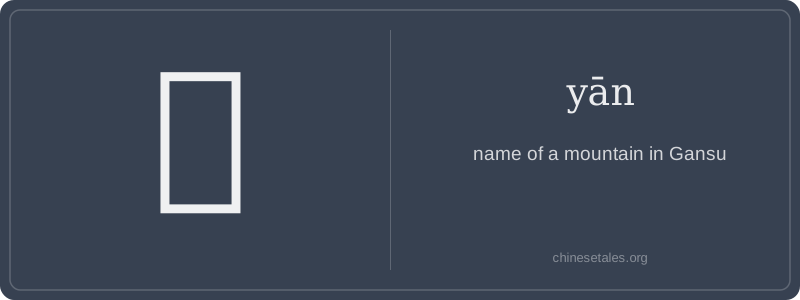
The earliest trace of 崦 appears not in oracle bone script (where it’s absent), but in early seal script around the Warring States period. Visually, it merges 山 (mountain) on the left with 阽 (yān, ‘precipice, danger’) on the right — though the right side later simplified to 央. In bronze inscriptions, the right component resembled a person standing at a cliff edge under a setting sun — evoking perilous western terrain. Over centuries, the strokes streamlined: the top stroke of 央 sharpened, the middle horizontal stabilized, and the mountain radical gained its familiar three-peaked shape — yielding today’s 11-stroke form.
By the Han dynasty, 崦 crystallized as part of 崦嵫, referencing a real mountain range near Dunhuang in Gansu — but quickly transcended geography. Qu Yuan’s Li Sao invoked ‘日忽忽其将暮兮,儵吾游乎崦嵫’ (‘The sun hurries toward dusk—I suddenly wander to Yanzi!’) cementing its role as the mythic western horizon. Its visual duality — mountain + ‘central precipice’ — mirrors its meaning: not just location, but liminality: the place where light ends, time bends, and mortal journeys conclude.
At first glance, 崦 looks like a mountain (山) with something draped over it — and that’s exactly the point. It’s not a generic ‘mountain’ character like 山 or 峰, but a highly specific toponymic glyph: the name of Mount Yan (崦嵫), a legendary western peak in Gansu where the sun was said to set in ancient Chinese cosmology. The character breathes poetic weight — it’s never used alone to mean ‘mountain’; it only appears in proper names or literary allusions, especially paired with words like 嵫 (yī) or 崦嵫 (yān zī). You’ll never see it on a street sign or in daily conversation — it’s reserved for classical poetry, historical geography texts, or modern writers invoking twilight imagery.
Grammatically, 崦 functions exclusively as a noun component in compound proper nouns — think of it like ‘Olympus’ in English: you wouldn’t say ‘I climbed an olympus’; you say ‘Mount Olympus’. So 崦 always appears in fixed collocations: 崦嵫 (yān zī), 崦嵫山 (yān zī shān), or in idioms like 日薄崦嵫 (rì bó yān zī, ‘the sun nears the western mountain’ — meaning ‘approaching the end of life’). Learners sometimes mistakenly treat it as a general mountain classifier or try to use it in verbs — a dead giveaway it’s been mislearned.
Culturally, this character is a time capsule. In the Chu Ci and Han dynasty fu poetry, 崦嵫 wasn’t just geography — it symbolized the boundary between day and night, life and decline. Modern learners often miss this resonance and read it phonetically without grasping its emotional gravity. Also, beware: its pronunciation yān sounds identical to 烟 (smoke) and 淹 (to flood), but shares zero semantic ground — confusing them breaks both logic and poetry.