崤
Character Story & Explanation
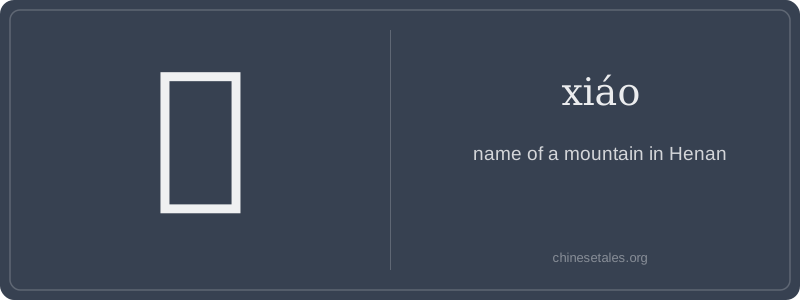
The earliest form of 崤 appears in Warring States bronze inscriptions as a stylized mountain peak (山) paired with a complex figure representing a tall, robed person — the ancestral form of 堯. Over centuries, that figure was streamlined: the head became 亠, the body condensed into ヨ-like strokes, and the feet merged into 灬 — but crucially, the mountain radical remained firmly atop, anchoring the character’s identity as terrain. By the Han dynasty clerical script, the shape stabilized into today’s 11-stroke structure: 山 on top, 堯 below, each stroke deliberate — three peaks, four dots, two horizontal bars, and a final downward sweep.
Its meaning never wavered: always the Xiáo Mountains — a narrow, treacherous corridor west of Luoyang, flanked by cliffs and guarded by the Hangu Pass. Sima Qian wrote of armies vanishing into its gorges; Du Fu lamented its ‘cold stones and broken banners’. The character itself became a metonym for strategic vulnerability — ‘the Xiáo passes’ evoked both geography and fate. Even today, when historians write 崤函之固 (‘the impregnable barrier of Xiáo and Hán’), they’re invoking not just hills, but the weight of empire-defining decisions made in those windswept valleys.
崤 (xiáo) is a geographical name character — not a verb, adjective, or abstract concept, but a proper noun frozen in time: the ancient Xiáo Mountains in western Henan, where the Yellow River bends and dynasties rose and fell. Visually, it’s a mountain (山) cradling two ‘crossroads’ — the left side 堯 (yáo), a phonetic component that once depicted a tall person with a headdress (later simplified), now purely signaling sound. Don’t try to ‘translate’ 堯 here — it’s not about ‘Yao the sage’; it’s about *how the word sounds*. This is classic Chinese phono-semantic compounding at its most elegant (and opaque).
Grammatically, 崤 appears almost exclusively in fixed historical-geographic terms — never as a standalone noun in modern speech, and never as a verb or modifier. You’ll see it only in compound names like 崤山 (Xiáo Shān) or 崤函 (Xiáo Hán), the famed strategic pass between mountains and rivers. Learners sometimes misread it as yáo or yáo-shān — a fatal slip, since 堯 alone means ‘emperor Yao’, and 崤 has zero connection to rulership or virtue. It’s pure topography: stone, slope, and silence.
Culturally, 崤 is a silent witness. In the Zuo Zhuan, the Battle of Xiáo (崤之战) in 627 BCE marked Qin’s first major defeat — a turning point etched into classical memory. Modern learners rarely encounter it outside history texts or place-name signs, so confusion often stems from overthinking: trying to infer meaning from 堯 instead of accepting it as a phonetic anchor. Remember: 山 tells you *what* it is (a mountain); 堯 tells you *how to say it* (xiáo). That’s the whole grammar.