崠
Character Story & Explanation
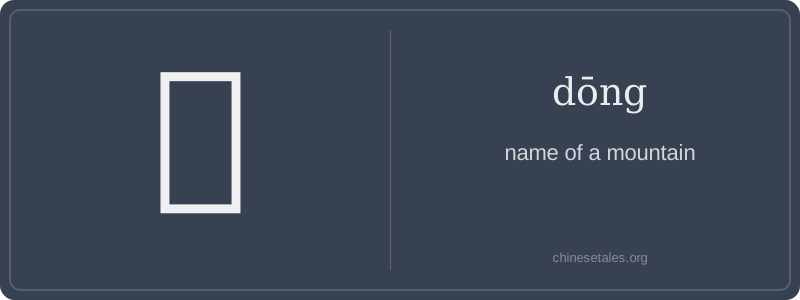
The character 崠 does not appear in oracle bone or bronze inscriptions — it’s a relatively late creation, likely emerging during the Northern and Southern Dynasties (420–589 CE) as a phonosemantic compound. Its left radical 山 (shān, ‘mountain’) visually anchors it to terrain, while the right component 東 (dōng, ‘east’) provides both sound and directional meaning — indicating ‘the eastern mountain’ in a specific regional context. Over time, the strokes standardized into today’s form: 山 + 東, with 東’s original ‘sun rising through trees’ pictograph simplified into its modern cursive shape.
This character was never abstracted into general use. Unlike 東, which evolved to mean ‘east’, ‘Oriental’, or even ‘Eastern’ in compounds like 东方 (dōngfāng), 崠 stayed tethered to one physical landmark — historically documented in the Yan Zhi Tu Ji (Gazetteer of Yanzhou Prefecture, Ming dynasty) as marking a sacred peak near present-day Linyi. Its visual logic is literal: ‘mountain of the east’ — not metaphorical, not poetic, but topographic precision frozen in ink.
At first glance, 崠 looks like a mountain-related character — and it is! But here’s the twist: it doesn’t mean ‘mountain’ in general. It’s a proper noun character, exclusively used as part of the name of a specific mountain — Mount Dong (Dōng Shān) in Shandong Province. In Chinese, many geographical names preserve ancient, highly localized characters that never entered general vocabulary or grammar. This reflects how deeply place-based Chinese culture is: a single character can be ‘retired’ from everyday use but kept alive for centuries just to honor one hill’s identity.
Grammatically, 崠 appears almost always in fixed proper nouns — never as a standalone word, never as a verb or adjective, and never in compounds you’d guess from its components. You’ll see it only in contexts like ‘Dōng Shān’ (东崠), not ‘high 崠’ or ‘climb 崠’. Learners sometimes mistakenly treat it like 山 (shān, ‘mountain’) and try to combine it — but no native speaker would say ‘崠顶’ (dōng dǐng); they’d say ‘山顶’ (shān dǐng). Its usage is fossilized, like a linguistic monument.
Culturally, characters like 崠 reveal China’s reverence for local geography and historical continuity: even obscure, non-HSK characters persist in official maps, gazetteers, and local signage because erasing them would feel like erasing memory itself. A common mistake? Assuming all mountain-related characters are productive — but 崠 is a ‘one-hit wonder’ of cartography, not vocabulary.