崟
Character Story & Explanation
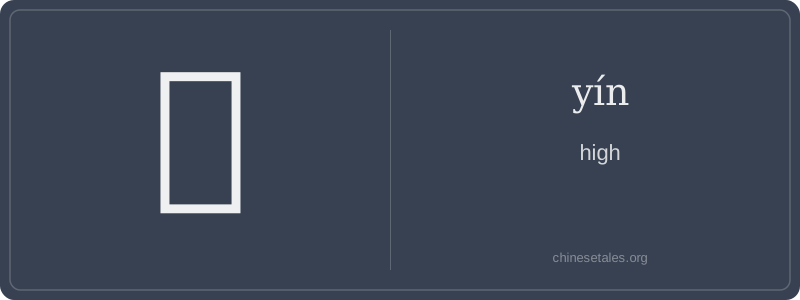
The earliest form of 崟 appears in seal script (zhuànshū), not oracle bones — it’s too late for that era. Visually, it’s a masterclass in semantic stacking: the radical 山 (shān, 'mountain') anchors the bottom, while the top component 吟 (yín, 'to chant, recite') isn’t just phonetic — it’s a clever visual metaphor. In ancient writing, 吟 was often drawn with a mouth (口) and 'command' (今), suggesting resonant, echoing sound — and what echoes more powerfully than a voice thrown against sheer, towering cliffs? Over centuries, the top simplified from a full 吟 to its modern form, but the mountain-stone-and-sonority fusion held firm.
This duality shaped its meaning: not mere vertical measurement, but height that *resonates* — height with presence, dignity, and acoustic weight. The Shījīng (Classic of Poetry) doesn’t use 崟 directly, but its semantic field appears in lines describing 'mountains rising like chants into heaven'. By the Tang dynasty, poets like Du Fu employed related compounds to evoke silent, monumental grandeur — a legacy where geology meets liturgy. Even today, when you see 崟 in a place name, you’re not just reading geography — you’re hearing millennia of echo off stone.
Imagine standing at the foot of a mist-shrouded mountain in southern China — not the jagged, snow-capped peaks of the north, but one of those ancient, densely forested ridges where the rock seems to breathe and the air hums with quiet majesty. That’s the feeling 崟 (yín) evokes: not just 'high' in a measurable sense, but *soaringly, solemnly high* — a height that inspires awe, reverence, and a touch of solemn stillness. It’s a poetic, literary word, rarely heard in daily speech, and never used alone as an adjective like 高 (gāo). You’ll almost always find it embedded in classical-style compound words or place names.
Grammatically, 崟 functions exclusively within multi-character nouns or adjectives — think of it as a 'flavor enhancer' for elevation: it adds gravity, antiquity, and natural grandeur. You won’t say 'the mountain is 崟'; instead, you’ll encounter it in phrases like 崟崟 (yín yín), where reduplication intensifies the sense of towering, unbroken height. Learners sometimes mistakenly treat it like a standalone descriptor — a classic trap, since using it solo sounds archaic or even nonsensical to native ears.
Culturally, 崟 belongs to the elegant, restrained lexicon of classical Chinese poetry and geographical nomenclature. It appears in ancient texts like the Shuōwén Jiězì (c. 100 CE) as a character denoting 'lofty mountains', and today survives primarily in proper nouns (e.g., Yínshān Mountain) and literary compounds. Its rarity means even many educated native speakers pause before pronouncing it — making it a quiet badge of linguistic depth, not conversational utility.