崞
Character Story & Explanation
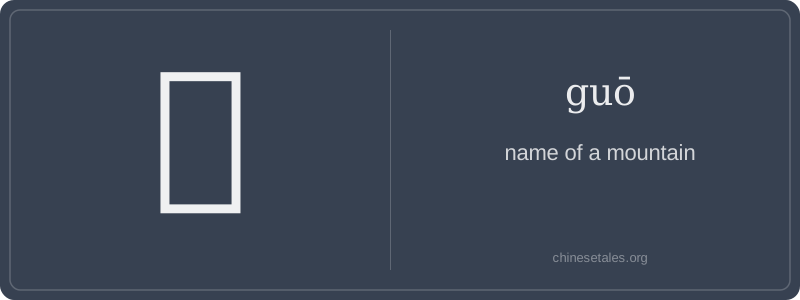
The earliest trace of 崞 appears in Han dynasty seal script, where it clearly shows 山 (mountain) on the left — three jagged peaks — fused with 果 (guǒ, 'fruit') on the right. But don’t be fooled: 果 here isn’t about apples. In ancient phonetic loan usage, 果 served purely as a *sound hint*, approximating the local pronunciation *guō*. The oracle bone and bronze inscriptions show no direct precursor; it emerged as a newly coined toponymic character during the Warring States period, likely created by scribes to transcribe a non-Sinitic place name — perhaps from a Xiongnu or Di tribal term for a prominent peak. Stroke-by-stroke, it evolved: the 山 radical stabilized early, while the 果 component simplified from a full pictograph of a tree bearing fruit (木 + 田 + 丿) into today’s streamlined 8-stroke form.
This character is a perfect example of 'phonosemantic compounding' — where meaning (mountain) and sound (guō) are split across radicals. Classical references are sparse but telling: the Commentary on the Water Classic (Shuǐ Jīng Zhù, 6th c.) mentions 'Guō Mountain lies north of Yanmen Pass', linking it to strategic defense. Visually, the contrast is poetic: the solid, grounded 山 anchors the character, while 果 — though silent in meaning — adds rhythmic balance and echoes the rounded, dome-like shape of the actual mountain in Shanxi. Its form hasn’t changed since the Han, making it a rare visual time capsule.
Think of 崞 (guō) like the Chinese equivalent of 'Mount Olympus' — not a generic word for mountain, but a proper name frozen in geography and history, much like how 'Alps' or 'Andes' refer to specific ranges rather than any hill. It’s a *geographic proper noun*, not a common noun: you’d never say 'a guō' or 'two guōs' — it only appears in fixed names, almost always as part of 崞县 (Guō Xiàn), a county in Shanxi Province named after Mount Guō. Unlike English place names that evolve phonetically (e.g., 'Cincinnati' → 'SIN-sin-AT-ee'), 崞 has preserved its ancient pronunciation and form for over two millennia — a linguistic fossil.
Grammatically, 崞 functions exclusively as a bound morpheme — it never stands alone in speech or writing. You’ll see it only in compound nouns: county names (崞县), historical texts (e.g., '崞山之北'), or modern administrative terms (崞阳镇). Learners sometimes mistakenly treat it like 山 (shān, 'mountain') and try to use it adjectivally ('guō mountain'), but that’s ungrammatical — it’s as if you tried to say 'Olympus mountain' instead of 'Mount Olympus'. Its role is purely nominal and lexicalized.
Culturally, 崞 carries quiet prestige: though obscure to most Mandarin speakers outside Shanxi, it appears in Tang dynasty poetry and Ming-era gazetteers as a marker of frontier geography — the northern edge of Han cultural reach. A common mistake is misreading its radical: learners glance at the right side (果) and assume it relates to fruit (guǒ), but the 山 radical dominates meaning — this is *mountain*, not *fruit*. Its obscurity makes it a delightful 'deep cut' for advanced learners exploring China’s layered toponymy.