崛
Character Story & Explanation
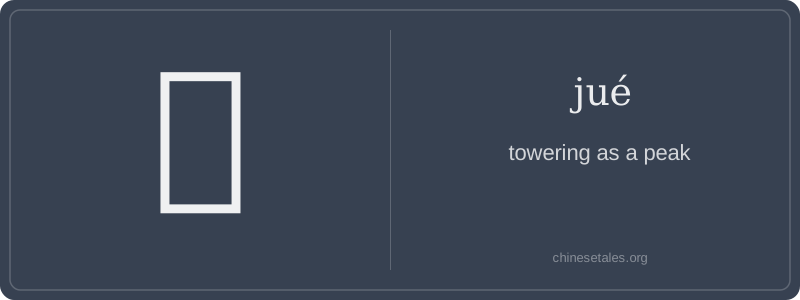
The earliest form of 崛 appears in seal script as 山 (mountain) fused with 屈 (qū, ‘to bend’ or ‘to yield’) — but here, 屈 isn’t about submission. Instead, its bent shape (originally depicting a person kneeling) was repurposed visually to suggest *coiled potential*, like a spring compressed beneath rock. Over centuries, the left 山 radical stabilized, while the right evolved from 屈’s complex form into the streamlined 亅 + 出-like structure we see today — eleven strokes capturing tension before release: the mountain isn’t static; it’s *pushing*.
This visual duality — mountain + contained force — crystallized into the meaning ‘towering emergence’ by the Han dynasty. In the Shuōwén Jiězì (121 CE), it’s glossed as ‘mountains rising abruptly’, used in descriptions of jagged peaks in southern Guangxi. By the late Qing, intellectuals like Liang Qichao revived 崛 in essays like ‘On the Great Rise of Asia’, transforming it from topographic descriptor to national metaphor — the mountain wasn’t just tall anymore; it was *awakening*.
Picture a mountain rising so fiercely it seems to tear itself from the earth — that’s the visceral energy of 崛 (jué). Its core meaning isn’t just ‘tall’ or ‘high’, but *dynamic emergence*: a peak thrusting upward with unstoppable force, like magma breaching crust or a nation shaking off centuries of slumber. In modern usage, it almost never stands alone — it’s the beating heart of compound verbs and literary metaphors, always implying sudden, powerful, often historic ascent.
Grammatically, 崛 is nearly always paired: 崛起 (jué qǐ) means ‘to rise up’ (e.g., a power rising geopolitically), while 崛然 (jué rán) is an elegant classical adverb meaning ‘toweringly’ or ‘abruptly prominent’. Learners sometimes misread it as a standalone adjective (‘towering!’), but it doesn’t function that way — you’d say 崛起的国家 (a rising nation), not *崛国家. It’s also easily mispronounced: jué rhymes with ‘yue’ in ‘Tao Yuanming’, not ‘jue’ as in ‘jungle’ — tone 2, not tone 1.
Culturally, 崛 carries profound weight: 崛起 is the official term for China’s modern resurgence — think headlines like ‘中华民族的伟大复兴与和平崛起’. Using it casually (e.g., ‘my coffee cup 崛起 on the desk’) would sound absurdly grandiose. The character breathes historical gravity; it’s reserved for tectonic shifts — nations, movements, or ideals breaking surface after long submersion.