崚
Character Story & Explanation
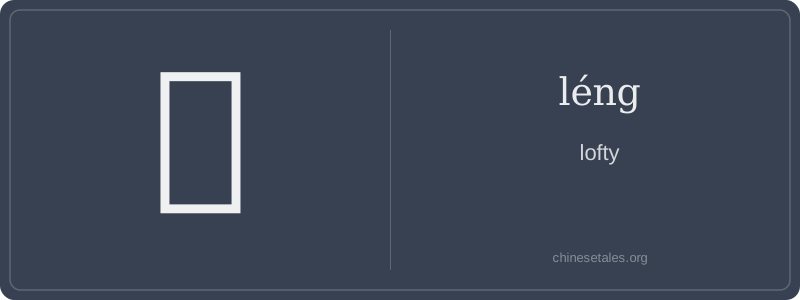
The earliest form of 崚 appears in seal script as two mountain-like peaks (山) stacked vertically, with a phonetic component ‘夌’ (líng, meaning ‘to ascend’) beneath—suggesting ‘mountains rising sharply upward’. Over time, the top ‘山’ simplified into the modern radical 山 (shān, ‘mountain’), while the lower part evolved from 夌 into 棱—retaining the sense of angular ascent. Crucially, the original pictograph wasn’t smooth—it emphasized *sharp ridges*, not gentle slopes: think of granite teeth biting the sky, not rounded hills.
This visual logic shaped its semantic path: from ‘steep, serrated elevation’ in early poetry (e.g., Tang poet Du Fu’s line ‘崚嶒石栈’—‘jagged stone plank roads clinging to cliffs’) to a broader aesthetic ideal of moral and physical uprightness. In Ming-Qing literati painting inscriptions, 崚 often described both actual mountain contours and the ‘lofty spirit’ of the artist—where form and virtue fused. Its rarity today isn’t decline, but preservation: it’s kept alive precisely because it refuses to be diluted.
Imagine standing at the foot of Mount Hua at dawn—the jagged, sheer cliffs pierce the mist like frozen lightning. That’s the visceral feeling of 崚 (léng): not just ‘tall’, but *austere, sharp-edged loftiness*—a vertical grandeur that commands silence and awe. It’s poetic, classical, and rarely used in daily speech; you won’t hear it in subway announcements or restaurant menus. Instead, it lives in literary descriptions, calligraphy scrolls, and names of mountains or temples—evoking dignity, remoteness, and unyielding height.
Grammatically, 崚 is almost always an adjective modifying nouns (especially geographical features), and it nearly always appears in compounds—not alone. You’d say 崚嶒 (léng céng) for ‘jaggedly towering cliffs’, not *‘this mountain is 崚’. It never takes aspect markers (了, 过) or degree adverbs like 很—so ‘很崚’ is unnatural and instantly marks a learner. Its tone (second tone) also trips people up: léng sounds like ‘leng’ in ‘length’, not ‘ling’—a common mispronunciation that muddies poetic nuance.
Culturally, 崚 carries Daoist and Chan Buddhist resonance: it’s the kind of height that invites contemplation, not conquest. Mistaking it for generic ‘tall’ misses its austerity—it’s less ‘skyscraper’ and more ‘monk’s cliff-side hermitage’. Learners often overuse it trying to sound literary, but native speakers reserve it for moments where the landscape itself feels morally upright—like stone with spine.