崒
Character Story & Explanation
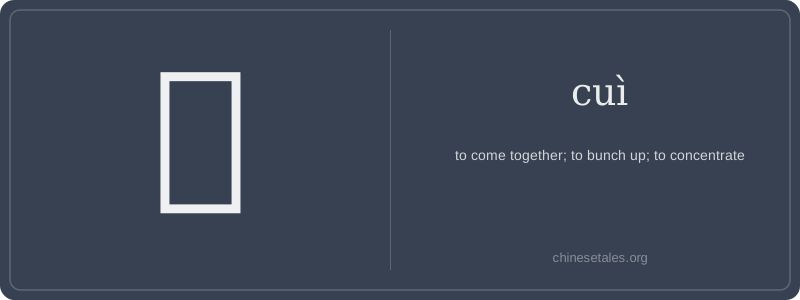
The earliest form of 崒 appears in seal script as a mountain (山) radical topped by a stylized cluster of three strokes representing converging lines or dense objects—like arrows pointing inward, or layered rock strata pressing together. Over time, the top evolved from three distinct diagonal strokes into the modern ‘卒’ component (zú, meaning ‘soldier’ or ‘end’), which visually suggests completion or culmination—reinforcing the idea of things coming to a head. The mountain radical anchors the character literally and semantically: mountains are natural sites of convergence—rivers meet at their foothills, paths converge at passes, and weather systems gather around peaks.
This visual logic deepened in classical usage. In the Wen Xuan (Selections of Refined Literature), 崒 appears in descriptions of ‘clouds 崒于西岭’—clouds not merely gathering, but *piling up with palpable density* against the western ridge. Later, in Ming dynasty military treatises, 崒集 described troops compressing into a narrow defile—a tactical concentration implying both power and vulnerability. Even today, its shape whispers this duality: the mountain stands firm while the ‘soldier’-top signals an organized, urgent assembly—not random clustering, but strategic massing.
Think of 崒 (cuì) as the Chinese equivalent of 'clumping'—not in a messy, chaotic way, but like magnetic filings snapping into precise alignment when a magnet appears: sudden, collective, and purposeful. Its core meaning isn’t just ‘to gather’—it’s *intensive concentration*, often implying density, urgency, or structural convergence (e.g., crowds thickening at a gate, clouds massing before thunder). Unlike common verbs like 集 (jí) or 聚 (jù), 崒 carries a poetic, almost physical weight—it’s rarely used in everyday speech but shines in classical allusions, literary descriptions, and formal compound words.
Grammatically, 崒 functions almost exclusively as a verb in literary or set phrases—not as a standalone predicate in modern sentences. You won’t hear ‘大家崒起来了’; instead, it appears tightly bound: e.g., 崒集 (cuìjí, 'to concentrate intensely'), where 崒 intensifies the gathering action. Learners mistakenly treat it like a casual synonym for 聚—leading to unnatural or archaic-sounding utterances. It also never takes aspect particles (了, 过, 着) on its own, unlike regular verbs.
Culturally, 崒 evokes imagery from classical landscape poetry and military strategy texts—where terrain, troops, or qi-energy ‘converge’ at a decisive point. Its alternate reading zú appears only in rare historical phonetic loan usages (e.g., in some Tang dynasty rhyme dictionaries), not in modern compounds—so cuì is the only pronunciation you’ll ever need. Skip zú unless you’re transcribing ancient rhymes—and even then, double-check context.