崎
Character Story & Explanation
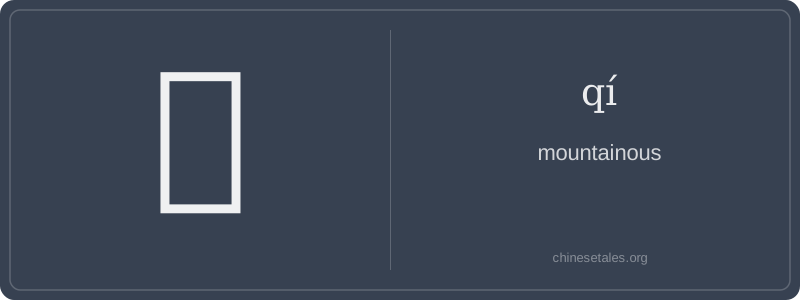
The earliest forms of 崎 appear in seal script (c. 3rd century BCE), where it clearly shows its dual nature: the left 山 (shān) radical — three upward strokes representing mountain peaks — anchors the character visually and semantically. On the right is 可 (kě), which originally depicted a mouth (口) with a stylized breath or command mark above — later evolving to mean ‘possible’ or ‘permissible’. In 崎, however, 可 isn’t used for meaning or sound alone; it’s a *phonetic loan* — its pronunciation (kě → qí via historical sound shift) was borrowed to approximate the local dialect word for ‘jagged terrain’, while 山 firmly rooted it in geography.
By the Han dynasty, 崎 stabilized into its modern structure — 11 strokes, with the mountain radical unmistakably dominant. Classical texts like the *Shuǐ Jīng Zhù* (Commentary on the Water Classic) use 崎 in compound form 崎嶇 to describe treacherous river gorges and winding passes. Interestingly, the character’s visual asymmetry — the slanted, off-kilter 可 leaning against the solid 山 — mirrors its semantic core: nature’s stubborn irregularity pressing against human order. It’s a rare case where the character’s imbalance isn’t a flaw — it’s the point.
At its heart, 崎 (qí) is all about rugged terrain — not just any mountain, but one with jagged ridges, steep slopes, and uneven contours. Think of the craggy spine of Taiwan’s Central Range or the wind-sculpted cliffs along China’s eastern coast. It’s an adjective that evokes visual texture and physical resistance: it doesn’t mean ‘tall’ like 峰 (fēng), nor ‘lofty’ like 巍 (wēi); it means *irregularly elevated*, often implying difficulty in passage or settlement. You’ll rarely see it alone — it almost always appears in compounds like 崎岖 (qí qū) or 崎嶇 (an older variant spelling).
Grammatically, 崎 functions exclusively as a modifier — never as a verb or noun. It doesn’t take aspect particles (了, 过) or degree adverbs like 很; instead, it partners tightly with other characters to form fixed two-character adjectives. For example, you say 崎岖的山路 (qí qū de shān lù, 'a rugged mountain road'), not *很崎 or *崎了. Learners often mistakenly treat it like a standalone descriptive word (e.g., *这座山很崎), but that’s ungrammatical — it’s linguistically ‘glued’ to its partner, usually 岖.
Culturally, 崎 carries subtle literary weight: in classical poetry and travel writing, it subtly conveys hardship, perseverance, or even moral fortitude — the path may be 崎岖, but the journey is noble. A common learner trap is misreading it as qǐ (like 起) due to tone confusion, or conflating it with 椅 (yǐ, 'chair') because of the 可 component — but their radicals, meanings, and pronunciations are worlds apart.