崃
Character Story & Explanation
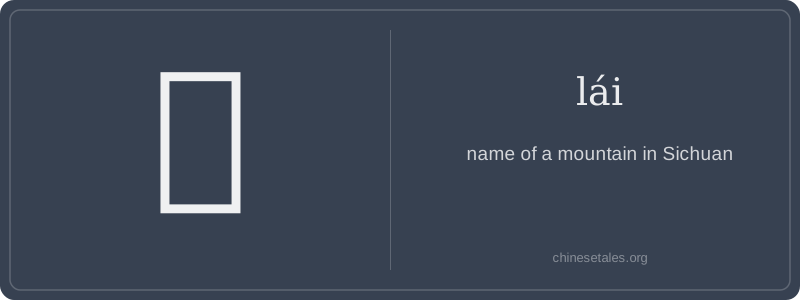
The earliest form of 崃 appears not in oracle bones but in Han-dynasty steles and later seal script, where it combines 山 (a stylized three-peaked mountain) on the left and 台 (a platform or terrace, originally depicting a raised earthen altar with steps) on the right. In bronze inscriptions, 台 was written with a ‘mouth’ (口) atop ‘to go’ (厶), suggesting a ceremonial platform — but by the Qin standardization, it simplified to the modern 台 shape. The ten strokes coalesced: 山 (3 strokes) + 台 (7 strokes), with the horizontal stroke of 台 extending slightly under 山’s right vertical to anchor the compound visually.
This wasn’t a descriptive invention — it was a phonetic loan. Ancient Sichuanese speakers called the mountain *lái*, and scribes borrowed the character 台 (which sounded close and carried connotations of elevated ground) to write it alongside 山 for semantic clarity. Unlike characters like 峰 (fēng, ‘peak’) that evolved metaphorically, 崃 froze in time as a geographic tag. The Shuǐ Jīng Zhù (6th c. CE) explicitly notes ‘Lái Shān lies west of Chengdu, its peaks layered like piled jade’ — confirming its role as a fixed toponym, not a lexical word. Its visual stability across 1,800 years mirrors the mountain’s own unchanging presence on the landscape.
Imagine you’re hiking the mist-shrouded ridges of western Sichuan, where a jagged granite spine cuts through cloud forest — that’s Mount Lái (Lái Shān), and 崃 is its name. This character isn’t abstract or poetic; it’s a proper noun with geological gravity — like ‘Alps’ or ‘Andes’ in English: specific, untranslatable, and deeply rooted in place. It carries no generic meaning beyond this mountain range near Chengdu, so you’ll never see it alone in a dictionary definition saying ‘steep’ or ‘peak’. It exists only as part of a proper name — almost always paired with 山 (shān, ‘mountain’) or in place names like 崃山市 (Lái Shān Shì, Lai Mountain City).
Grammatically, 崃 functions exclusively as a phonetic-semantic compound in toponyms — the 山 radical signals ‘mountain’, while the 台 component (lái) gives pronunciation and no independent meaning. You’ll never use it as a verb, adjective, or standalone noun. Learners sometimes mistakenly treat it like a descriptive character (e.g., writing *‘this hill is 崃’*), but that’s nonsensical — just as you wouldn’t say ‘this hill is Alps’. It’s not a quality; it’s an identity.
Culturally, 崃 evokes biodiversity and quiet majesty: the mountain shelters giant pandas, ancient Taoist temples, and tea plantations famed since the Tang Dynasty. Its exclusion from HSK reflects a pragmatic truth — learners don’t need it for daily communication — but encountering it on a map or travel blog is your first brush with China’s deep regional geography. The biggest mistake? Pronouncing it ‘lài’ (like 来) — it’s lái, with rising tone, matching the ancient name recorded in the Shuǐ Jīng Zhù (Commentary on the Water Classic).