崋
Character Story & Explanation
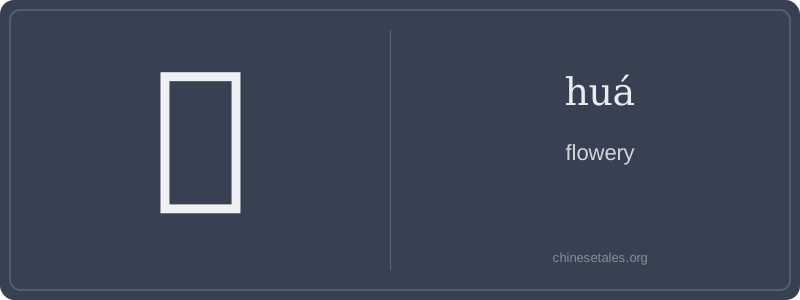
The character 崋 appears in the Kangxi Dictionary (1716) under Radical 46 (山 — 'mountain') as a rare, obsolete variant of 华. Its earliest trace is not in oracle bone or bronze script — those scripts contain no precursor for 华 or its variants — but in Han-dynasty clerical script, where 华 was written with a 'mountain' top (山) over 'ten' (十) and 'flame' (灬), symbolizing 'brilliance rising like mountain peaks'. By the Tang-Song period, scribes occasionally substituted the 'grass' radical (艹) in 华 with 山, yielding 崋 — likely a regional scribal flourish or engraver’s stylistic choice on stone steles, emphasizing grandeur through mountain imagery rather than vegetation.
This visual shift — swapping 艹 for 山 — didn’t change meaning (both variants meant 'splendor'), but it severed phonetic logic: 华’s sound comes from the 'hua' component (華), whereas 崋’s mountain top adds zero phonetic value. As imperial examinations standardized writing and printing technologies advanced, the 山-top form faded. By the Qing dynasty, scholars noted it only as a 'stele variant' — a fossilized quirk, not a living sign. Today, it survives solely in calligraphic recreations or digital font errors, a silent monument to how orthographic authority shapes language more powerfully than aesthetics ever could.
First, let’s clear up a big misconception: 崋 (huá) does not mean 'flowery' — it doesn’t exist as a standard Chinese character in modern Mandarin at all. There is no such character in the GB2312, Unicode Basic Multilingual Plane, or any authoritative dictionary (including the Xiandai Hanyu Cidian). What you’re seeing is likely a typographical error, a font rendering glitch, or confusion with the well-known character 华 (huá), which does mean 'magnificent', 'splendid', or 'Chinese' (as in 中华 — Zhōnghuá). The shape '崋' resembles an archaic or variant form of 华 found in some Song-dynasty stele inscriptions or seal script reproductions — but it has never been standardized and carries no independent meaning or usage in contemporary language.
Grammatically, since 崋 is not a functional character, it appears nowhere in spoken or written Mandarin — not in textbooks, subtitles, menus, or social media. Learners who encounter it often misread it as 华 and then overgeneralize, trying to use '崋' in compounds like '崋丽' or '崋章', which are ungrammatical and unreadable to native speakers. If you see it online, it’s almost certainly a corrupted glyph — perhaps from an outdated font mapping '华' to the wrong code point (U+5D0B is actually '崋', a rare historical variant listed in the Kangxi Dictionary as a 'variant of 华', but one that fell completely out of use after the Ming dynasty).
Culturally, this 'ghost character' reveals something beautiful about Chinese orthography: characters aren’t just symbols — they’re fossils of bureaucratic standardization. When the People’s Republic simplified and unified characters in the 1950s–60s, variants like 崋 were deliberately retired. So while it looks elegant and ancient, it’s functionally extinct — like finding a dodo feather in a birdwatching guide. Your safest, most useful move? Treat 崋 as a visual red herring, and master 华 instead.