崆
Character Story & Explanation
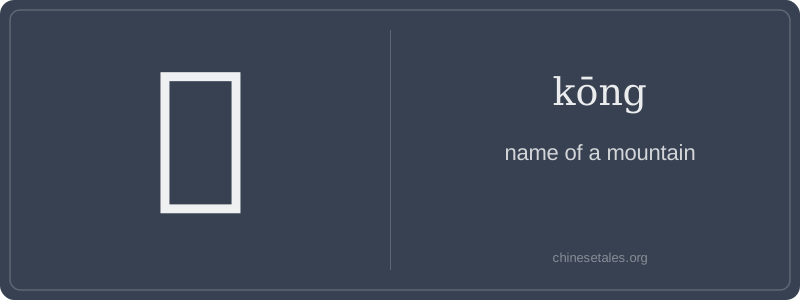
The earliest trace of 崆 appears not in oracle bones but in Han-dynasty bronze inscriptions and seal script, where it was already a compound character: 山 on the left, and 空 on the right — no simplification, no variation. The left side, 山, was unmistakably three jagged peaks (like a simplified mountain silhouette). The right side, 空, evolved from a pictograph of a cave or opening under a roof (宀 + 工), later stylized into today’s form. Crucially, the two parts were never fused — they remained distinct, like twin pillars: one rooted in earth, the other reaching skyward. Over centuries, clerical script smoothed the strokes, but the balance held — eleven clean, deliberate strokes, each carrying weight: three for 山, eight for 空.
This visual duality mirrors its meaning: the Kongtong Mountains are famed not just for their physical grandeur but for their metaphysical 'emptiness' — the quiet vastness where thought dissolves. Zhuangzi recounts the Yellow Emperor ascending Kongtong to seek wisdom from the sage Guangchengzi, who dwells 'where yin and yang meet and all things return to stillness.' So 崆 isn’t named for rock or height, but for the profound silence *between* peaks — a space so resonant it became a proper name. Even today, Taoist pilgrims chant 'Kōngtóng' not as a description, but as a mantra — the mountain’s name *is* its essence.
At its heart, 崆 (kōng) isn’t a descriptive word — it’s a proper noun with deep geographical roots. It doesn’t mean ‘mountain’ in general (that’s 山), nor does it evoke height or ruggedness like 峰 or 岭. Instead, it’s the name of a specific, legendary mountain range: the Kongtong Mountains (崆峒山) in Gansu Province — a Taoist sacred site where the Yellow Emperor is said to have studied immortality. Visually, the character radiates stillness and antiquity: the 山 radical anchors it firmly in the landscape, while the right side, 空 (kōng, ‘empty’ or ‘sky’), adds a philosophical resonance — not emptiness as lack, but as boundless, meditative space. This dual-layered identity makes it feel less like vocabulary and more like a whispered place-name on an old silk map.
Grammatically, 崆 appears almost exclusively in proper nouns — never as a standalone verb, adjective, or common noun. You won’t say ‘a kōng mountain’; you’ll say 崆峒山 (Kōngtóng Shān) — always capitalized in effect, even without capital letters. Learners sometimes misread it as 空 (kōng) alone and insert it into generic sentences ('This mountain is kōng!'), which sounds nonsensical — like calling Mount Fuji 'Tokyo Mountain' mid-sentence. Its usage is fossilized: it lives only in fixed, culturally loaded compounds, much like 'Alps' or 'Himalayas' in English — unchangeable, revered, and never pluralized.
Culturally, 崆 carries silent weight. In classical texts like the Zhuangzi, the Kongtong Mountains symbolize the threshold between human striving and cosmic stillness. Mistaking 崆 for 空 (which shares the same pronunciation and right-hand component) is the #1 error — leading learners to accidentally erase millennia of Taoist geography and replace it with abstract philosophy. Remember: when you see that 山 radical glinting on the left, you’re not looking at 'emptiness' — you’re standing at the foot of a mountain where sages walked.