峿
Character Story & Explanation
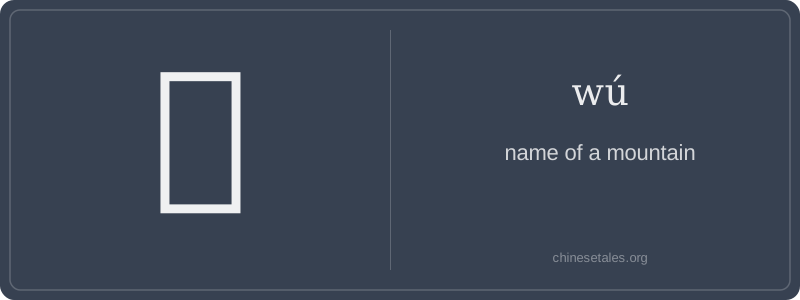
The earliest trace of 峿 appears not in oracle bones, but in Han-dynasty bronze inscriptions and later seal script, where it emerges as a deliberate compound: the mountain radical 山 (shān) on the right — unmistakable and stable — fused with a left-side component that evolved from 叙 (xù, 'to narrate') but was simplified over centuries into the modern 亐 (a rare variant of 于, yú). That left side wasn’t pictographic — it was phonetic, chosen for its approximate sound (wú), while 山 grounded it in meaning. Visually, it’s a marriage of sound + sense: the mountain is literal; the left side is a carefully selected 'sound-alike' borrowed from another word.
This character crystallized during the Han–Tang period as Chinese toponymy became systematized — scholars needed precise, unambiguous characters for regional landmarks to avoid confusion in administrative texts and poetry. 峿 appears in Tang-era geographical records like the Yuanhe Junxian Tu Zhi, always paired with 山. Its visual weight — those balanced, slightly ornate strokes — reflects its function: dignified, official, and immovable. Unlike abstract characters that drifted in meaning, 峿 stayed fiercely local, its form a silent contract between language and land.
Let’s be honest: 峿 (wú) is a quiet celebrity — it doesn’t appear in daily conversation, HSK lists, or even most dictionaries you’ll casually flip through. But don’t dismiss it! This character exists for one elegant, precise purpose: to name a specific mountain — Mount Wú (峿山), a real, historically documented peak in Shandong Province. Its meaning isn’t generic ('mountain') like 山 (shān) or 岳 (yuè); it’s a proper noun, like 'Everest' — unchangeable, geographically anchored, and deeply local. Think of it as Chinese cartography in character form.
Grammatically, 峿 only appears in proper names — almost always as part of the compound 峿山 (wú shān), never alone or in verbs/adjectives. You won’t say 'I climbed 峿'; you’d say 'I visited 峿山'. Learners sometimes mistakenly treat it like a free-standing noun or try to use it in compounds like 峿顶 (wú dǐng) — but that’s not attested; native usage strictly preserves its identity as a fixed toponymic unit. It behaves like a surname for mountains: unique, uninflected, and respectfully singular.
Culturally, 峿 embodies how classical Chinese encodes geography with poetic economy — one character, one place, zero ambiguity. A common mistake? Confusing it with 吴 (wú, 'Wu state') or 无 (wú, 'without'), both homophones but utterly unrelated. Pronunciation alone won’t save you here — the radical and context are your lifeline. Remember: if you see 山 on the right and a complex left side, you’re looking at a mountain’s name tag — not a philosophical concept or a dynasty.