峹
Character Story & Explanation
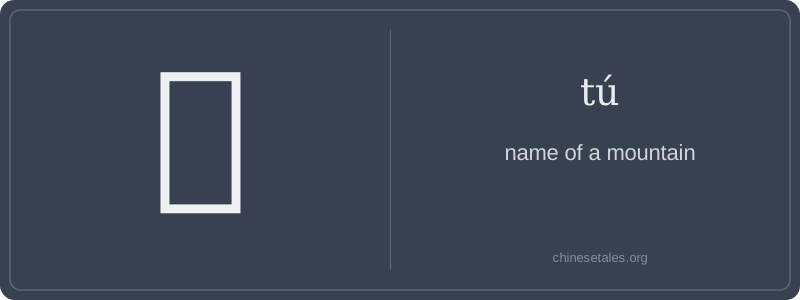
The earliest form of 峹 appears in bronze inscriptions of the Western Zhou (c. 1046–771 BCE) as a stylized mountain peak flanked by two simplified peaks — a triple-peak glyph (⛰️⛰️⛰️) atop a base representing land or terrain. Over centuries, the three peaks condensed into the top component 山 (shān), while the lower part evolved from a phonetic indicator *tú* (now lost in modern pronunciation) into the distinctive 口 (kǒu, 'mouth') shape — not because it means 'mouth', but because the ancient script borrowed that shape for its sound value. By the Han dynasty, the structure solidified into today’s 山 + 口: a mountain (meaning) anchored by a phonetic relic (sound).
This character never strayed from its original purpose: naming one specific mountain — the ancient Tú Mountain near present-day Yantai, revered in early Daoist cosmology as a site of immortality quests. Its unchanging usage reflects how Classical Chinese preserved geographical names with ritual precision: unlike descriptive terms like 高山 (gāo shān, 'tall mountain'), 峹 was never reinterpreted — it remained a fixed star in the textual firmament. Even in the Shuōwén Jiězì (121 CE), Xu Shen defined it plainly as 'a mountain name', refusing metaphorical expansion — a rare case of lexical austerity in a language rich with poetic ambiguity.
Think of 峹 (tú) as Chinese cartography’s version of 'Mount Doom' from Tolkien — a proper noun so specific and ancient that it exists only to name one real, legendary peak in Shandong Province. Unlike common nouns like 山 (shān, 'mountain') or even poetic ones like 岳 (yuè, 'lofty mountain'), 峹 carries zero generic meaning: it’s not used in compounds, never appears in idioms, and doesn’t function as a verb or adjective — it’s purely a geographical signature, like 'Ben Nevis' or 'Kilimanjaro' in English. You’ll never say 'a tú' or 'the tú'; you just say 峹 — full stop.
Grammatically, it behaves like any proper noun: no measure words, no particles like 的 unless possessive ('峹的南坡', 'the southern slope of Tú Mountain'), and almost always appears with 山 (e.g., 峹山) for clarity — though the character itself *means* 'mountain'. That’s the first trap: learners see the 山 radical and assume it’s a general term, but it’s not — it’s a fossilized name. In classical texts, it appears unadorned in place-name lists, like an entry in a Han dynasty gazetteer: '峹,東萊之山也' ('Tú: a mountain in Donglai').
Culturally, its obscurity is its charm: it’s a linguistic time capsule. Modern Mandarin speakers rarely encounter it outside historical geography or rare surnames (yes — some families bear the surname 峹!). The biggest mistake? Confusing it with 圖 (tú, 'map') — same pinyin, wildly different meaning and shape. Remember: if you’re drawing a map, you need 圖; if you’re hiking an obscure sacred peak in Shandong, you need 峹.