峱
Character Story & Explanation
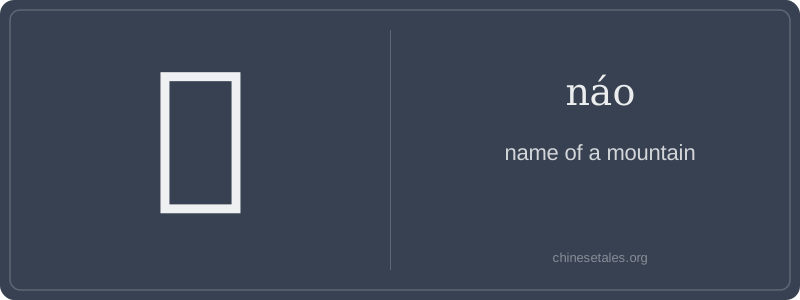
The earliest form of 峱 appears in bronze inscriptions from the late Zhou dynasty — not as a pictograph, but as a phonosemantic compound already fully formed: the left side 山 (shān, 'mountain') as semantic indicator, and the right side 奴 (nú, 'slave') as phonetic clue (the sound shifted from nú → náo over centuries). Visually, it’s elegant austerity: three stacked horizontal strokes atop the mountain radical evoke layered ridges, while the 奴 component adds vertical stability — like a mountain held upright by ancient labor. Over time, clerical script simplified the 奴’s 'hand' (又) into a cleaner diagonal stroke, and regular script standardized the balance between the soaring peak and grounded base.
Its meaning never wavered: always the name of one particular mountain — Mount Náo — located near present-day Zibo in Shandong. The Shānhǎi Jīng describes it as 'where the sun rises' and notes 'white tigers dwell on its slopes', linking it to eastern cosmology and dawn symbolism. Unlike most mountain names that evolved into poetic metaphors (e.g., 泰山 Tàishān symbolizing greatness), 峱 remained geographically anchored — a rare case where a character preserved its original referent across 2,300 years without semantic drift or literary inflation. Its visual calm mirrors its lexical stillness: no drama, no metaphor — just stone, sky, and silence.
Think of 峱 (náo) like the 'Mount Olympus' of Chinese geography — not a household name, but a real, ancient mountain with mythic weight. It’s not a generic word for 'mountain' (that’s 山 shān), nor does it describe terrain like 'peak' or 'ridge'; it’s purely a proper noun — the name of a specific mountain in Shandong Province, first recorded over two millennia ago in the Classic of Mountains and Seas (Shānhǎi Jīng). In modern usage, you’ll almost never encounter it outside historical texts, gazetteers, or scholarly discussions of early Chinese topography — much like how English speakers might know 'Mount Ararat' or 'Mount Sinai' not as everyday landmarks, but as culturally anchored names tied to origin stories.
Grammatically, 峱 functions strictly as a noun and appears only in fixed place names — never as a verb, adjective, or component in compound verbs. You won’t say 'to 峱' or 'very 峱'; it’s inert in that way. Learners sometimes mistakenly treat it like a descriptive character (e.g., confusing it with 岩 yán 'rocky cliff') or try to use it generically — a dead-end move, since no native speaker would say 'let’s hike up 峱' without specifying *which* 峱 (and there’s only one!). Its grammatical life is as still and singular as the mountain itself: a frozen proper noun in a sea of functional vocabulary.
Culturally, 峱 is a quiet time capsule. Its inclusion in the Shānhǎi Jīng places it among legendary peaks associated with immortals, floods, and cosmic boundaries — yet unlike Kunlun or Tai, it never entered poetry or idiom. That’s the nuance: it’s historically attested but linguistically dormant. Common mistakes? Misreading its radical (山) as a clue to meaning — yes, it’s under the 'mountain' radical, but that only signals *category*, not *definition*. And pronunciation trips many up: náo rhymes with 'cow' but starts with an 'n', not 'l' — so 'now' is closer than 'law'.