峪
Character Story & Explanation
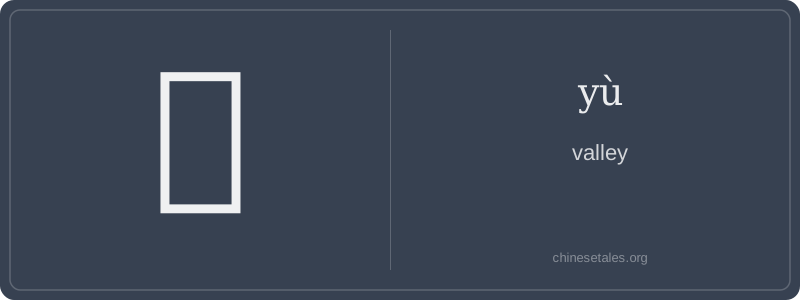
The earliest form of 峪 appears in seal script (around 300 BCE), where it clearly combines 山 (shān, mountain) on the left with 谷 (gǔ, valley) on the right — not as a phonetic loan, but as a semantic reinforcement. The left radical 山 anchors it in the mountainscape; the right side 谷, though later stylized, originally depicted two streams converging in a hollow — a pictograph of water flowing into a depression between hills. Over centuries, the right-hand component simplified: the two ‘drops’ (冫) merged into a single stroke, and the central ‘mouth’-like enclosure became the compact 谷 we know today — resulting in the modern 10-stroke structure.
This character wasn’t common in early texts — it first gained traction during the Northern Wei dynasty (386–534 CE), appearing in stele inscriptions describing military routes through mountainous terrain. By the Tang dynasty, poets like Wang Wei used it subtly in landscape verse to imply sheltered depth — e.g., ‘松风生夜凉,石峪敛余暑’ (Pine wind cools the night; the stone valley gathers away the last summer heat). Visually, the character itself is a mini-landscape: 山 looms left, 谷 recedes right — your eye travels inward, just as a traveler would descend into a real yù.
峪 (yù) is a beautifully precise word for a narrow, often mountain-enclosed valley — think steep-sided gorges carved by rivers or hidden passes between peaks. It’s not just any 'valley' like the more generic 谷 (gǔ); 峪 carries a sense of geological intimacy: rock walls leaning in, wind whistling through, paths winding upward. You’ll rarely hear it in casual speech — it’s literary, geographical, and deeply tied to terrain description, especially in northern China.
Grammatically, 峪 functions almost exclusively as a noun, usually embedded in proper nouns (like place names) or compound words. You won’t say *‘wǒ zài yù lǐ’* (I’m in a valley) — that sounds oddly poetic or archaic. Instead, you’ll encounter it in fixed terms: Juyongguan (Juyong Pass), where ‘guan’ means pass and ‘yu’ implies the valley the pass cuts through. It never appears alone in modern spoken Mandarin; its presence signals topography, history, or official naming — like finding ‘gorge’ or ‘defile’ on a British Ordnance Survey map.
Culturally, 峪 evokes frontier landscapes — the Great Wall snakes through dozens of yùs, and classical poetry uses it to suggest seclusion, strategic vulnerability, or quiet grandeur. Learners often misread it as 谷 (gǔ) due to similar meaning and shape — but confusing them erases the nuance: 谷 is broad and agricultural; 峪 is narrow and geological. Also, don’t try to use it as a verb or modifier — it doesn’t conjugate, pluralize, or take aspect particles. It’s a fossilized terrain noun — majestic, specific, and quietly uncompromising.