峨
Character Story & Explanation
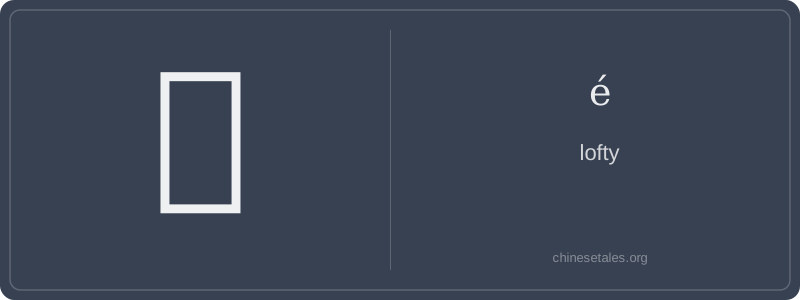
The earliest form of 峨 appears in seal script (around 200 BCE), where it clearly combines 山 (mountain) on the left with 我 (wǒ, ‘I’) on the right — not as a pronoun, but as a phonetic component (both pronounced *é* in Old Chinese). Visually, the 山 radical anchors it in the landscape, while the 我 side evolved from a bronze-inscription glyph depicting a weapon-like tool with a sharp point — later stylized into today’s 10-stroke form: three peaks of 山 (丨冂丨) plus 我’s distinctive hook-and-dot structure (丿、一、丶、亅, etc.). Every stroke feels like ascending terrain — jagged, deliberate, unyielding.
This phonetic-semantic pairing was genius: 山 gives meaning (mountainous height), 我 gives sound (*é*) — and over time, the ‘I’ shape subtly reinforced the sense of proud, self-contained elevation. By the Tang dynasty, 峨 was already entrenched in poetry to describe not just peaks but anything impressively upright: Li Bai wrote of ‘峨冠’ (towering hats) and ‘峨舸’ (majestic boats). Its visual weight — ten strokes, dense and balanced — mirrors its semantic weight: it doesn’t whisper ‘tall’ — it declares ‘lofty’ with the gravity of stone and silence.
At its heart, 峨 (é) isn’t just ‘lofty’ — it’s *visually majestic*, evoking the awe of standing beneath a sheer, craggy mountain peak that scrapes the clouds. In Chinese, this isn’t abstract height; it’s vertical grandeur with presence and dignity — think of a scholar’s bearing, a temple gate’s imposing arch, or the mist-wreathed cliffs of Mount Emei. You’ll rarely see 峨 alone: it almost always appears in compounds or proper nouns, never as a standalone adjective like ‘tall’ in English.
Grammatically, it’s strictly literary and formal — absent from spoken Mandarin and daily conversation. You won’t hear ‘this building is é’; instead, you’ll read ‘峨冠博带’ (é guān bó dài) describing a Ming-dynasty official’s towering hat and wide sash — where 峨 modifies ‘guān’ (hat) to mean ‘towering, stately’. It functions only as a modifier before nouns (never after), and never takes aspect particles (了, 过) or degree adverbs (很, 非常). Learners often mistakenly try to use it predicatively — a red flag that instantly sounds archaic or poetic (and usually wrong).
Culturally, 峨 reflects China’s deep-rooted association between physical elevation and moral/spiritual stature — mountains aren’t just landforms; they’re cosmic pillars and Daoist sanctuaries. Its near-exclusivity to classical allusions and place names (like 峨眉山) means encountering it is like opening a scroll painting: it signals reverence, antiquity, and intentional elegance. Mistake it for a general-purpose ‘high’ word, and you’ll sound like someone quoting Confucius at a coffee shop — impressive, but wildly out of place.