峞
Character Story & Explanation
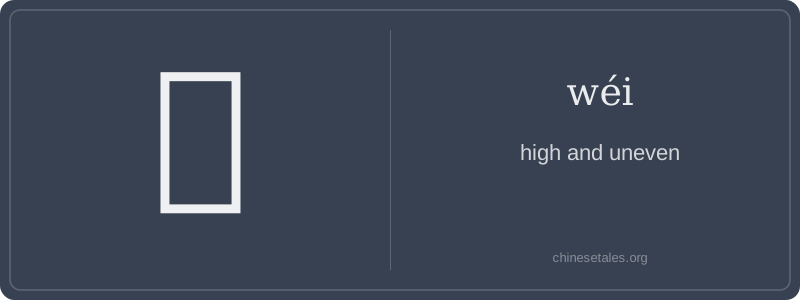
The earliest form of 峞 appears in Han dynasty clerical script (lìshū), evolving from the older character 巍 (wēi), which itself derived from oracle bone inscriptions depicting three stacked mountain-like peaks (山 ×3) atop a base — symbolizing overwhelming, layered height. 峞 simplifies this: its left side 山 (shān, mountain) anchors the meaning, while the right side 聿 (yù, originally a hand holding a brush) was later stylized into 禾 + 女 + 一 — but crucially, this component evolved phonetically to signal pronunciation (wéi), not meaning. Over centuries, stroke simplification flattened the peaks and tightened the structure, yielding today’s balanced yet angular form.
By the Six Dynasties period, 峞 began appearing in geographical texts and epitaphs to describe mountains with dramatic vertical variation — not just tall, but *disruptively* elevated, like the Wuyi Mountains’ fractured cliffs. It’s notably absent from the Shuōwén Jiězì (121 CE), confirming its late emergence as a variant of 巍. Its visual rhythm — sharp peaks on the left, a complex, 'busy' right side — mirrors its semantic duality: physical height fused with textural irregularity, making it one of Chinese writing’s most geologically vivid characters.
Think of 峞 (wéi) as the linguistic equivalent of hiking a jagged, windswept mountain ridge — not just tall, but *unevenly* so: peaks jut, slopes crumble, and the terrain refuses to be smooth. Its core meaning 'high and uneven' evokes visual texture, not mere elevation — it’s about irregular grandeur, like the serrated skyline of Guilin karsts or ancient fortress walls built into rocky cliffs. Unlike generic height words like 高 (gāo), 峞 is deeply descriptive and almost poetic, rarely used in casual speech or modern prose.
Grammatically, 峞 functions almost exclusively as a stative adjective, typically appearing in literary or classical-style compounds (e.g., 峞巍 wéiwēi, meaning 'lofty and rugged'). You won’t find it alone in sentences like 'The mountain is 峞' — that would sound archaic or unnatural. Instead, it thrives in reduplicated forms or fixed expressions, often modifying nouns like 山 (shān, mountain) or 岭 (lǐng, ridge). A common learner mistake is trying to use it predicatively ('这座山很峞') — but native speakers would say 这座山巍峨 or 这座山峥嵘, never *很峞.
Culturally, 峞 carries an understated but potent resonance: it appears in Tang dynasty poetry and stele inscriptions describing sacred or imperial terrain, subtly reinforcing the Daoist and Confucian idea that true majesty lies in unrefined, asymmetrical natural power — not symmetry or polish. Modern usage is vanishingly rare outside compound words or calligraphic art, making it a quiet relic of classical landscape aesthetics.