峙
Character Story & Explanation
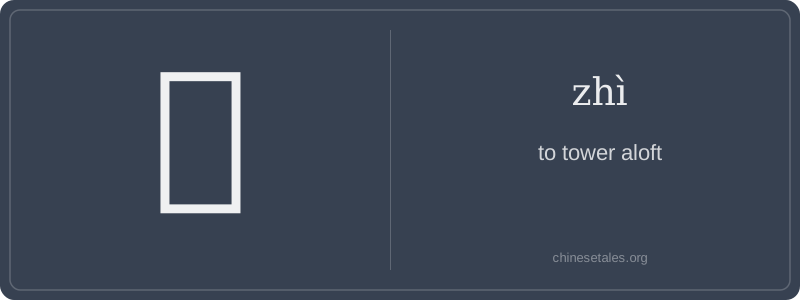
The earliest form of 峙 appears in seal script (c. 3rd century BCE), where it already combined 山 (mountain) on the left with 寺 (sì, originally meaning 'government office' or 'temple', later phonetic) on the right. But look closer: in bronze inscriptions, the right side wasn’t yet 寺 — it resembled 止 (zhǐ, 'to stop'), suggesting 'mountain that halts movement' — an imposing natural barrier. Over centuries, the right component standardized into 寺 (which shares the zhì sound), while the left 山 radical remained unmistakably mountainous, anchoring the meaning in terrain-based dominance.
This visual logic held firm across dynasties. In the Classic of Mountains and Seas, 峙 described peaks 'guarding celestial gates'; by the Tang, poets like Li Bai used it to personify mountains as sentinels ('危峰峙天外'). The character never softened — unlike many words that drifted toward metaphor, 峙 kept its spine straight: it’s always about *vertical assertion*, whether literal cliffs or metaphorical power blocs. Even today, when journalists write '两岸对峙', they’re invoking that same ancient image — two forces, like opposing ridges, refusing to yield ground.
Think of 峙 (zhì) as the Chinese verb for 'standing tall and unshakable' — not just physically, but in presence, authority, or strategic dominance. It’s not everyday speech; you won’t hear it ordering baozi at breakfast. Instead, it evokes majestic mountains rising defiantly, or generals holding fortified positions — a word steeped in gravity, stillness, and sovereign verticality. Its core feeling is *imposing elevation*: something that doesn’t just sit — it looms with quiet command.
Grammatically, 峙 is almost always used in compound verbs like 对峙 (duì zhì, 'to face off') or 耸峙 (sǒng zhì, 'to tower sharply'), rarely alone. It’s transitive only in literary contexts (e.g., ‘峰峦峙立’ — 'peaks stand erect'), and never takes aspect markers like 了 or 过. Learners often mistakenly use it like 站 (to stand) — but 峙 isn’t about posture; it’s about *geographic or symbolic dominance through height and immovability*. Saying '他峙在门口' is unnatural; say '他矗立在门口' instead.
Culturally, 峙 appears heavily in classical poetry and military history — think Du Fu describing mountain passes guarding imperial borders, or Ming dynasty texts on frontier garrisons '雄峙边关'. Modern usage leans poetic or journalistic: headlines about geopolitical standoffs ('美中两军对峙南海') or travel essays ('孤峰耸峙云海之上'). A common mistake? Confusing its sharp, upward energy with the passive stability of 立 or the gentle rise of 矗 — 峙 carries tension, readiness, even latent confrontation.