峇
Character Story & Explanation
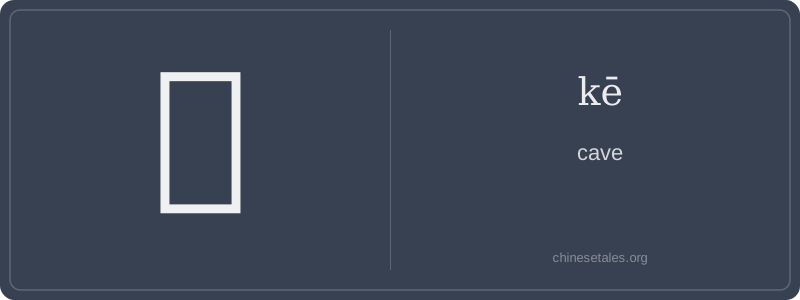
The earliest form of 峇 appears in late Warring States bronze inscriptions as a mountain (山) with three stacked horizontal lines and a curved stroke beneath — not random marks, but a deliberate pictograph of a mountain face with a recessed, tiered cavity. Over centuries, those layers condensed into the modern right-hand component: the top two strokes became the inverted 'V' (冖-like shape), the third line fused into the horizontal base, and the curve evolved into the final dot-and-stroke flourish — all preserving the idea of depth within stone. Crucially, this wasn’t drawn from above (like a map), but from the human perspective: standing at the cave mouth, looking inward, feeling the cool air rise.
By the Han dynasty, 峇 was already archaic in daily use, preserved mostly in texts like the Shuōwén Jiězì, which defines it as 'a deep, hidden cave in the mountain' — emphasizing concealment over size. In Tang poetry, it appears in lines like '峇岫含云色' ('The cave-ridge holds cloud-color'), where it conveys stillness, mystery, and vertical seclusion. Unlike 洞 (which implies passage or utility) or 窟 (associated with dwellings or tombs), 峇 resists domestication: its shape insists on wild, unentered depth — a silent counterpoint to the mountain’s outward height.
Forget everything you thought you knew about 'cave' in Chinese — 峇 (kē) isn’t your standard, dictionary-approved cave character like 洞 (dòng) or 窟 (kū). It’s a rare, almost fossilized glyph that survives mainly in ancient place names and classical poetry, where it evokes a very specific kind of cave: narrow, mountain-embedded, shadow-draped, and quietly sacred. Visually, it’s unmistakably mountain-born (radical 山), but the right side isn’t just decorative — it’s a stylized representation of an opening with layered depth, not a simple hole. Think less 'bat-filled cavern' and more 'hermit’s secluded grotto where mist pools at dawn.'
Grammatically, 峇 almost never appears alone in modern speech or writing. You’ll find it only as part of proper nouns — especially old geographical terms like 峇山 (kē shān) or poetic compounds such as 峇岫 (kē xiù), meaning 'cave-mountain ridge'. Learners mistakenly try to substitute it for common words like 洞, but that’s like using 'grotto' instead of 'cave' in every sentence — technically possible, but instantly marks you as quoting Song dynasty anthologies, not ordering lunch. Its tone kē is stable here; the kè reading appears only in obscure phonetic loan usages (e.g., in ancient transcriptions of non-Chinese names), not in semantic 'cave' contexts.
Culturally, 峇 carries Daoist and reclusive literary resonance — it’s the kind of cave where sages withdraw, not where tourists take selfies. Mistake it for 山 (shān, 'mountain') or 岩 (yán, 'rock'), and you’ll lose the precise sense of enclosed, sheltered interiority. Also, watch your tone: saying kè instead of kē won’t get you understood — it’ll likely prompt a polite, puzzled pause, like mispronouncing 'quiche' as 'quick-ee' at a Parisian bistro.