峁
Character Story & Explanation
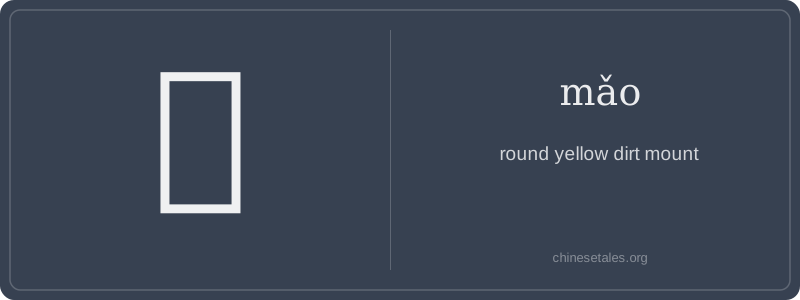
The earliest form of 峁 appears in late bronze inscriptions and Han dynasty seal script as a stylized mountain (山) topped by a rounded, enclosed shape — not a square, but a soft, oval-like enclosure representing a smooth, domed summit. Over centuries, the upper part simplified into 口 (kǒu, 'mouth'), losing its pictorial roundness but retaining the idea of a closed, bounded crest. The 山 radical stayed firmly at the bottom, anchoring its meaning in terrain. By the Tang dynasty, the modern structure — 山 + 口 — was standardized: eight clean strokes, with the 口 sitting squarely atop the mountain like a lid on a gentle earthen loaf.
This evolution reflects how Chinese writing often prioritizes functional clarity over literal depiction. Though 口 doesn’t mean 'mouth' here, its closed, compact shape visually echoes the *enclosed, rounded contour* of a true mǎo — distinct from jagged peaks (峰) or long ridges (岭). Classical texts rarely use 峁 alone; it appears in regional gazetteers like the Shaanxi Tongzhi (1540s), describing landforms where 'the soil is deep, the mǎo are numerous, and the wind sweeps clean'. Its persistence for 2,000 years proves how deeply language can root itself in local earth — not philosophy or poetry, but the very dust under farmers’ feet.
峁 (mǎo) is a wonderfully specific, regionally rooted word — it doesn’t mean just any hill, but specifically a *rounded, bare, loess-covered mound* found across China’s Loess Plateau in Shaanxi, Shanxi, and Gansu. Think of smooth, dome-shaped dirt hills sculpted by wind and rain over millennia — no trees, no rocks jutting out, just soft, yellow earth swelling gently from the ground. It’s not poetic or abstract; it’s geological vocabulary with local flavor, used almost exclusively in place names and descriptive geography.
Grammatically, 峁 functions as a noun — never a verb or adjective — and rarely stands alone. You’ll almost always see it in compound nouns like 梁峁 (liáng mǎo, 'ridge-and-mound') or in toponyms: Liangjia Mǎo (梁家峁), Zhangjiagou Mǎo (张家沟峁). Learners sometimes mistakenly treat it like a general synonym for 山 (shān, 'mountain') or 岭 (lǐng, 'ridge'), but that’s like calling a sand dune a ‘mountain’ — technically elevated, but missing all the cultural and physical nuance. It carries no emotional weight (unlike 峰 for ‘peak’ or 崖 for ‘cliff’), just quiet, earthy precision.
Culturally, 峁 is a linguistic fossil of Northwest China’s landscape — so tied to loess topography that it rarely appears outside regional texts, land surveys, or folk songs. A common mistake is misreading its radical: though it contains 山 (shān, 'mountain'), it’s not about height or grandeur — it’s about *shape and soil*. Also, don’t confuse it with the similar-sounding 茂 (mào, 'lush') or 卯 (mǎo, the zodiac rabbit hour) — tone and context matter, but the visual shape (especially that distinctive 口 on top) is your best anchor.